
Glassdoor reviews influence who applies to work for you. Because they are anonymous, many employers feel powerless against unfair ones. You cannot simply delete a review, but there are legitimate ways to flag content that breaks Glassdoor's rules, respond effectively and change the overall picture.
For many employers, Glassdoor is the first place a candidate looks. A handful of angry reviews can lengthen your hiring process, so it is natural to look for ways to remove them. The platform is clear, though: it is not designed to remove reviews simply because an employer disagrees.
That does not leave you without options. Understanding exactly what Glassdoor removes, and what your response can achieve, helps you decide where to spend your effort.
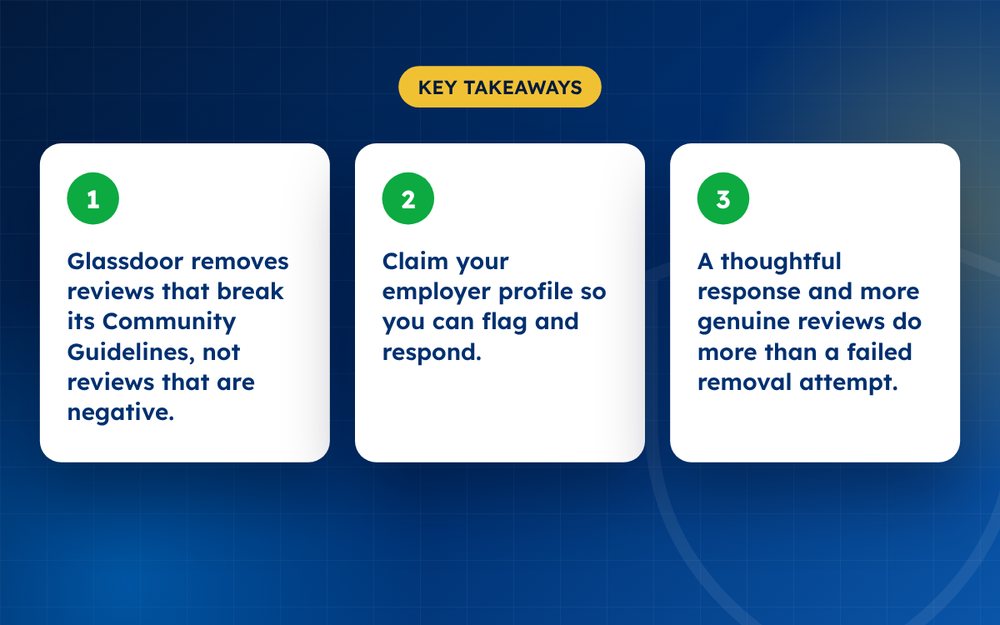
- Glassdoor removes reviews that break its Community Guidelines, not reviews that are negative.
- Claim your employer profile so you can flag and respond.
- A thoughtful response and more genuine reviews do more than a failed removal attempt.
What Glassdoor may remove
Glassdoor's guidelines generally rule out content such as:
- Discriminatory language, hate speech, threats or harassment
- Naming or attacking individuals in a way that breaks guidelines
- Confidential information, trade secrets or personal data
- Promotional content, spam or reviews that are not about a real experience of working there
- Reviews that appear to come from someone with a conflict of interest
- Content that is off-topic or contains claims that cannot be an employee's firsthand experience
A review that is one-sided, emotional or critical of management is normally allowed. The test is whether it breaks the rules, not whether it is fair.
How to flag a review
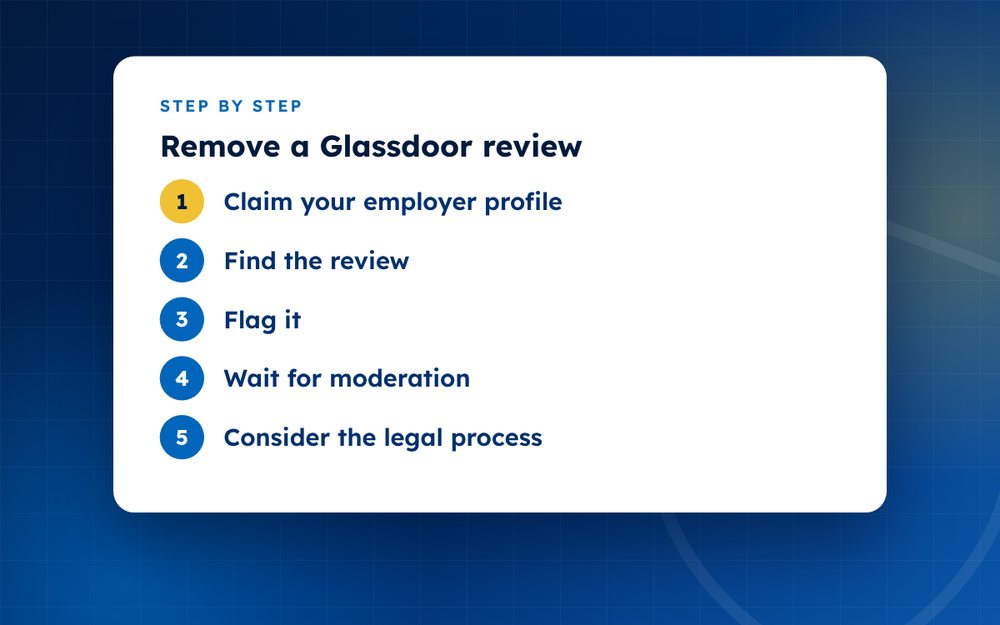
- Claim your employer profileCreate a free employer account and verify that you represent the company. This gives you access to reviews and the ability to respond.
- Find the reviewOpen the review from your employer dashboard or the public company page.
- Flag itUse the flag option and select the guideline you believe is broken. Explain briefly and factually what is wrong.
- Wait for moderationGlassdoor's team reviews flags and may remove the review, or decide it stays. A rejected review can sometimes be flagged again if you have new information.
- Consider the legal processFor content that is defamatory, Glassdoor handles court orders and legal requests separately. Ask a lawyer whether this fits your situation.
Understanding Glassdoor's approach
Glassdoor positions itself as a place for current and former employees to share honest experiences anonymously. Its moderation team reviews content against its Community Guidelines. Because it cannot verify every claim, it generally leaves reviews up when they appear to be a genuine opinion about working at a company, even if the opinion is harsh.
What it does act on are clear breaches: discriminatory language, threats, naming of individuals in ways that break the rules, confidential information, spam and promotional content. If your concern fits one of those categories, flagging is worthwhile. If it does not, your time is better spent on a response and on improving what employees say.
Writing a flag that works
- Name the specific guideline you think the review breaks
- Quote the exact words that cause the problem, rather than summarising
- Avoid emotional language and personal attacks on the reviewer
- Be clear about whether the content is a statement of fact or an opinion
- Provide context only if it directly supports your point
Working with the review you cannot remove
A calm, specific reply is one of the most effective things you can do. It signals that leadership listens. Do not try to identify the author, do not argue and do not post a long defensive reply. Thank the reviewer, acknowledge the concern, describe what you are doing or reviewing and invite further conversation through HR.
Then look at the bigger picture. If several reviews raise the same issue, such as workload, communication or management behaviour, that is useful information. Fixing it will improve future reviews more than anything else.
Responding to a negative review
Your reply is public and permanent, and candidates read it. Thank the reviewer, avoid defensiveness, correct facts only when necessary and describe what you are doing about the issue. Never try to identify the reviewer.
Improve the overall picture
- Ask current employees to share their honest experiences. Never script them or offer rewards
- Fix recurring complaints, then say publicly what changed
- Keep your profile updated with photos, benefits and company information
If you are dealing with a campaign of false or abusive reviews, a specialist can help assess what can be flagged and what strategy makes sense.
Frequently asked questions
Can an employer delete a Glassdoor review?
No. Employers can flag a review, respond to it and claim their profile, but only Glassdoor can remove a review. Glassdoor decides based on its guidelines and, in some cases, on valid legal orders.
Can I find out who wrote a review?
No. Reviews are anonymous, and Glassdoor does not give employers the identity of reviewers. Trying to work out who wrote a review, or confronting employees you suspect, is risky and can create legal and reputational problems.
Will Glassdoor remove a review that is false?
Only if it breaks the guidelines or a valid legal process requires it. A statement being inaccurate is not always enough. Glassdoor usually treats reviews as opinions of employees, unless they clearly cross a line, such as accusing a named person of a crime.
Does responding make a review worse?
A calm, factual response normally helps. Candidates read employer responses, and a thoughtful reply improves how you appear. Defensive, angry or sarcastic replies can damage your employer brand much more than the review itself.
How long does Glassdoor take to review a flag?
There is no fixed timeline. Many flags are reviewed within days, while some take longer, particularly if they raise complex issues. Check your employer account for updates. Avoid flagging the same review repeatedly unless you have new information, because duplicate flags do not speed up the process.
Should I ask employees to post positive reviews?
You can invite employees to share honest feedback, but never script, reward or pressure them. Reviews that look manufactured can be removed and can damage trust in your company.
Need help with this?
Every situation is different. Email us the details in confidence and we will reply with an honest assessment of what can be done.
Contact us by email Glassdoor ReviewsThis guide is general information, not legal advice. DMCA Reputation is not a law firm.
Related guides
How to Remove a Google Review: A Complete Guide for Business Owners
How to remove a Google review: what Google will remove, how to report it, how to appeal and what to do if it stays. A guide for business owners.
Read the guide · 6 min
Can You Delete a Google Review? What Google Will and Won't Remove
Can you delete a Google review? Learn who can delete one, what Google removes on request, and what your options are when a review will not come down.
Read the guide · 5 min
How to Report a Fake Google Review, Step by Step
How to report a fake Google review step by step: spotting fakes, flagging from your Business Profile, evidence to gather and what to do if it stays.
Read the guide · 5 min