
Getting a rejection message from Google after reporting a review is common. It does not always mean the review must stay. Often the report was too general or did not match a policy. Here is how to reassess and try again properly.
A rejection feels final, but it often is not. Many rejected reports fail for fixable reasons, such as choosing the wrong category, giving too little detail or reporting a review that is simply negative. Before you give up, it is worth understanding why the decision was made.
At the same time, it is important to be realistic. Some reviews are allowed under Google's rules even though they are unfair. In those cases your effort is better spent on reply and recovery.
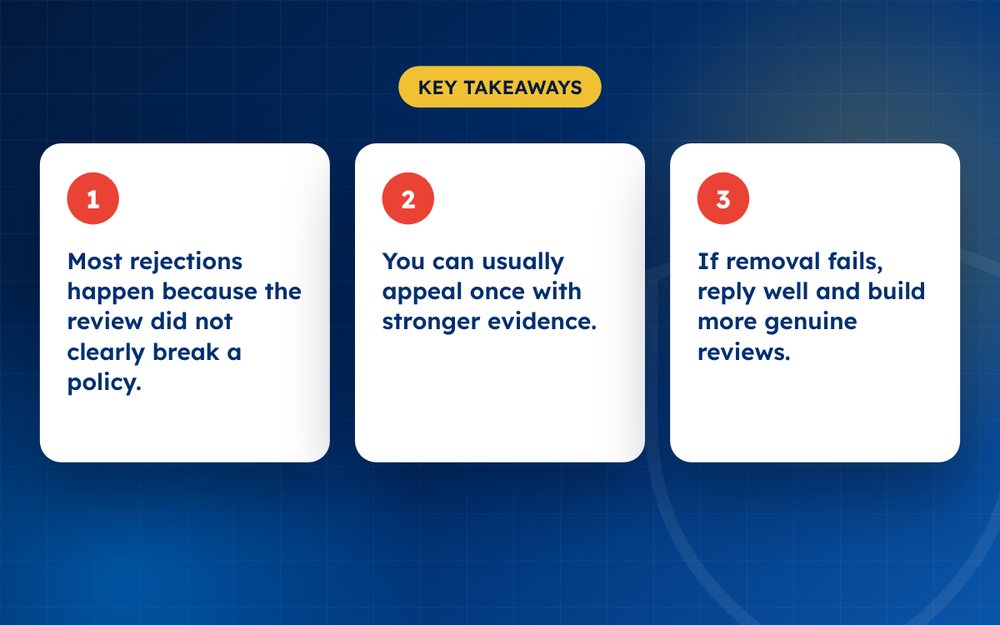
- Most rejections happen because the review did not clearly break a policy.
- You can usually appeal once with stronger evidence.
- If removal fails, reply well and build more genuine reviews.
Why requests are rejected
- The review is negative but describes a real experience
- The wrong reason was chosen when reporting
- No evidence was given that the reviewer was not a customer
- The review was reported many times without new information
- The content does not break any listed policy
What to do next
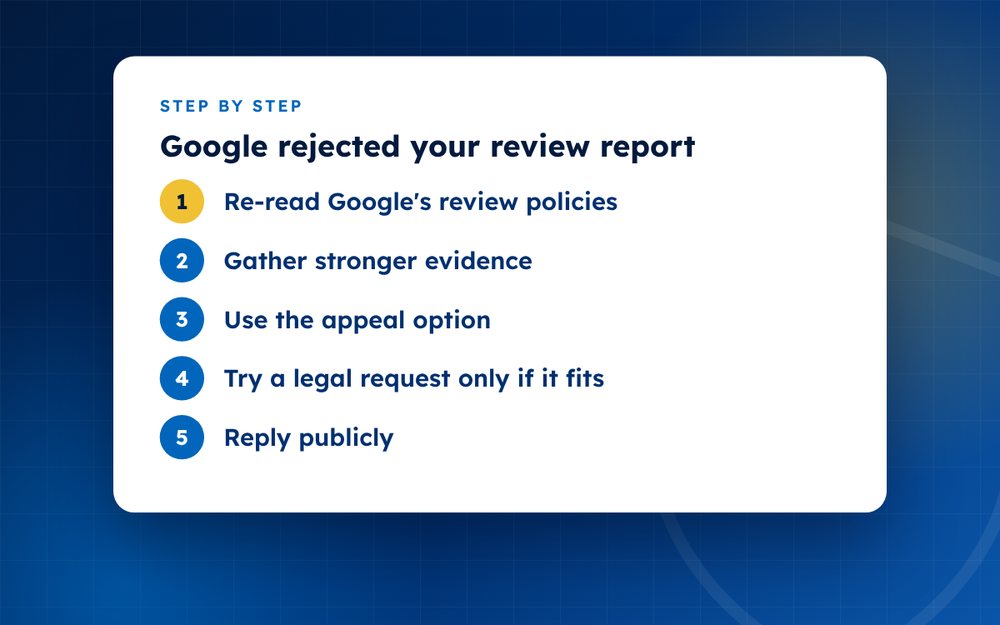
- Re-read Google's review policiesCompare the review against each policy. Pick the one it truly breaks.
- Gather stronger evidenceRecords showing no customer match, proof of a conflict of interest, or screenshots of the reviewer's pattern of fake reviews.
- Use the appeal optionIn the reviews management tool, appeal the decision and explain clearly why the review is a violation.
- Try a legal request only if it fitsIf the review contains false statements of fact, a legal removal request may apply. Get legal advice first.
- Reply publiclyRespond calmly and factually so future customers see your side.
- Invite honest feedbackInvite genuine customers consistently to leave honest reviews, without selecting them by expected sentiment or offering incentives.
Reading the decision carefully
Google's message is usually short. It may say that the review does not violate policy or that no action was taken. Read it alongside the content policies. Ask yourself whether the review contains something that is clearly prohibited, such as hate speech, personal information or a conflict of interest, or whether it is an opinion about your service.
Strengthening an appeal
- Quote the exact policy that you believe the review breaks
- Add one or two sentences of evidence, not a long story
- Attach proof, such as records that show the reviewer was never a customer
- Point to a pattern, for example several reviews from the same account or a burst in a short time
- Keep the tone calm and professional
When a legal request might be appropriate
If the review contains a clear false statement of fact that is damaging, such as accusing you of a crime, Google has a legal removal process. Requirements differ by country, and you should speak to a lawyer before using it. Do not rely on legal threats to the reviewer, which can backfire and spread the review further.
Moving on productively
If the review stays, reply publicly and focus on collecting more reviews. A thoughtful reply, combined with a steady stream of recent, genuine reviews, often matters more to future customers than a single removed review.
What a better second attempt looks like
Imagine you reported a review as fake and it was rejected. For the appeal, you might add that the reviewer's account has posted reviews for twelve unrelated businesses in different countries on the same day, attach screenshots of those reviews and confirm that your booking system has no record of the reviewer. That is a very different case from the first report, because it replaces suspicion with evidence.
If you cannot find any additional evidence, accept that the review may be permitted and put your energy into the reply and into collecting new reviews.
Do not offer anything in return for a deletion, and do not harass the reviewer. Both make things worse.
If you are not sure the review can be removed, email us and we will give you an honest view.
Official sources
Frequently asked questions
Can I report the same review again?
Only if you have new information or a stronger reason. Repeating an identical report rarely changes the decision and can make your account look careless. If you have fresh evidence, such as proof that the reviewer was never a customer, use the appeal option and explain clearly what is different from your first report.
Does Google explain its decision?
Usually only briefly. The message might say that the review does not violate policy, without giving details. Compare the review against Google's content policies to work out the likely reason, and ask yourself whether your report gave enough evidence. That comparison tells you whether an appeal is worthwhile or whether you should focus on replying.
Is it worth hiring someone?
Only if the case is strong or the volume is high. Be wary of anyone promising guaranteed removal. A specialist can help assess whether a review genuinely breaks a policy.
What if the review is defamatory?
Defamation is a legal concept, and the standard is often high. If the review contains a clear false statement of fact that harms you, Google has a legal removal process, and requirements differ by country. Speak to a qualified lawyer before using it, because it can be slow and costly, and legal threats to the reviewer can backfire.
Can I contact the reviewer directly?
If you know who they are and they are a real customer, a polite message to resolve the issue can help. Never offer incentives and never pressure them.
Will an appeal affect my account?
A reasonable, honest appeal does not harm your account. What can cause problems is submitting repeated, aggressive or false reports, which may be treated as abuse of the system. Keep your appeal factual, give new evidence where you have it and avoid sending the same appeal several times.
Need help with this?
Every situation is different. Email us the details in confidence and we will reply with an honest assessment of what can be done.
Contact us by email Google ReviewsThis guide is general information, not legal advice. DMCA Reputation is not a law firm.
Related guides
How to Remove a Google Review: A Complete Guide for Business Owners
How to remove a Google review: what Google will remove, how to report it, how to appeal and what to do if it stays. A guide for business owners.
Read the guide · 6 min
Can You Delete a Google Review? What Google Will and Won't Remove
Can you delete a Google review? Learn who can delete one, what Google removes on request, and what your options are when a review will not come down.
Read the guide · 5 min
How to Report a Fake Google Review, Step by Step
How to report a fake Google review step by step: spotting fakes, flagging from your Business Profile, evidence to gather and what to do if it stays.
Read the guide · 5 min