
The right to be forgotten, formally the right to erasure and delisting, lets people in some regions ask search engines to remove certain results that appear for their name. It is not absolute, and each request is weighed against public interest.
The right to be forgotten is often described as a right to erase your past. In practice, it is a narrower right to ask search engines to stop showing certain results for a search of your name, in specific circumstances.
It is a balancing exercise between your privacy and the public's interest in information.
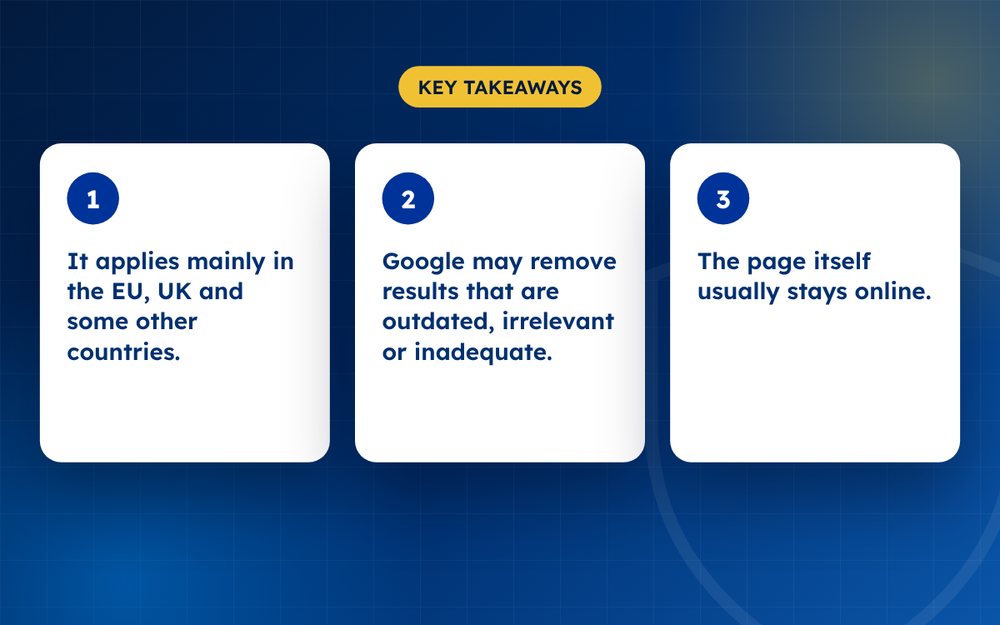
- It applies mainly in the EU, UK and some other countries.
- Google may remove results that are outdated, irrelevant or inadequate.
- The page itself usually stays online.
Who can use it
People in the EU and UK commonly use it, and some other countries have similar rules. Where you live matters. Other regions may offer limited or no equivalent.
What strengthens a request
- The information is outdated or no longer relevant
- You are a private individual with no public role
- The result is inaccurate or misleading
- It relates to a minor matter long past
- It reveals sensitive personal data
Steps
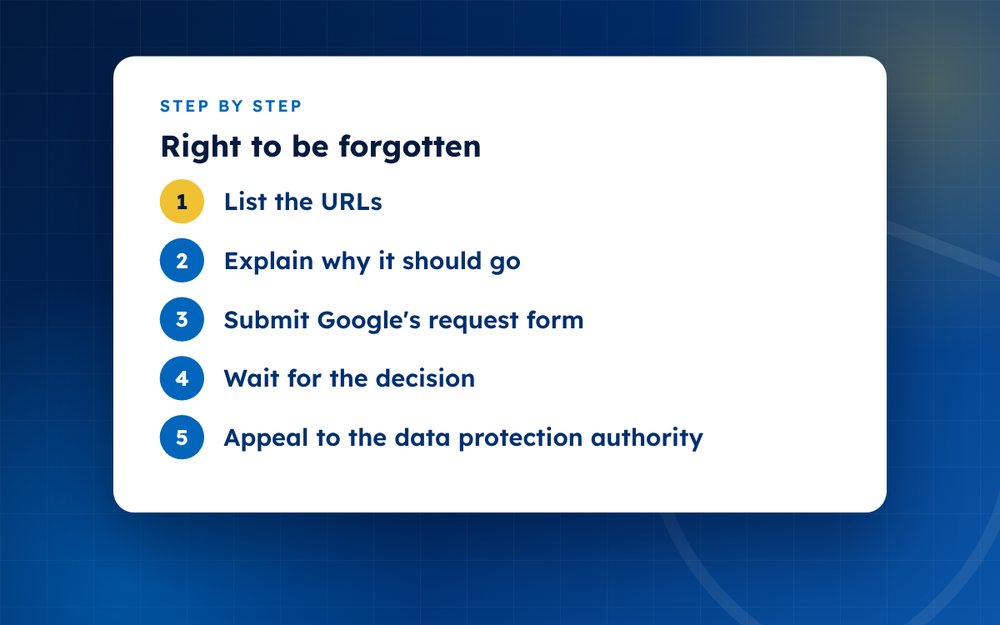
- List the URLsGather each link that appears for your name.
- Explain why it should goDescribe how it harms you and why it is not in the public interest.
- Submit Google's request formUse the form for legal removal requests under data protection law. Attach identification if asked.
- Wait for the decisionGoogle may approve, partially approve or refuse.
- Appeal to the data protection authorityIf refused, you may be able to complain to your national authority.
- Request Bing and othersRepeat the process for other engines.
How Google assesses a request
Google looks at whether the information is inaccurate, inadequate, irrelevant or no longer relevant, and whether it is in the public interest. For example, information about a minor offence long ago is more likely to be delisted than a recent matter relating to a professional's conduct. Public figures face a higher bar.
Making a strong request
- List each URL individually
- Explain why each result is outdated or irrelevant
- Give details about the passage of time
- Show how the result harms you
- Attach identification if asked
If your request is refused
In some countries you can complain to your national data protection authority or go to court. A lawyer can advise on whether to do so. You can also combine the request with suppression to reduce the visibility of the page.
Evidence that helps
Strong requests are supported by documents. If the original matter was resolved, attach the court decision, a settlement letter or a statement from the authority. If the information is outdated, show dates. If you are a private person, explain that you have no public role. Keep your request concise. Reviewers read many requests, and clarity helps.
If you do not have documents, explain in plain language what happened and why it is no longer relevant.
We can help you prepare a clear request. We are not a law firm and cannot give legal advice. Email us in confidence.
Frequently asked questions
Does it delete the article?
No. It stops the article appearing in searches for your name. The article remains online and may be found through other searches or direct links. If you want it removed entirely, you need to ask the publisher, which is a separate process.
Does it work outside Europe?
Rules differ. The right to be forgotten originates in European law, and similar rights exist in some other countries, but others have different privacy laws or none. Google may apply decisions within the region where the law applies. Check what applies where you live.
Will every request succeed?
No. Public interest often outweighs privacy, particularly for recent events, professional conduct or serious matters. Requests have a better chance when the information is outdated, irrelevant or inaccurate. A clear explanation and evidence help.
Can I use it as an executive or public figure?
Public figures face a higher bar because the public has a greater interest in information about their role. You may still succeed for matters unrelated to your public role or for outdated information. Be realistic and consider other strategies such as suppression.
Does it apply to Bing?
Bing has its own request process, so submit a separate request. Each search engine makes its own decision. Keep your requests consistent and keep records of each outcome.
How long does it take?
Often weeks, and sometimes longer. Google may ask for additional information, which can extend the process. Keep an eye on your email and respond quickly to any questions.
Need help with this?
Every situation is different. Email us the details in confidence and we will reply with an honest assessment of what can be done.
Contact us by email Right to Be ForgottenThis guide is general information, not legal advice. DMCA Reputation is not a law firm.
Related guides
How to Remove a Negative Article From Google Search
How to remove a negative article from Google search: contact the publisher, use Google's tools and legal routes, or suppress it when removal fails.
Read the guide · 4 min
How to Remove a News Article From the Internet
How to remove a news article from the internet: approaching publishers, correction and anonymisation requests, legal grounds and search options.
Read the guide · 4 min
How to Remove Your Name From Google Search Results
How to remove your name from Google search results: what you can remove, Google's results about you tool, data brokers and what to do about the rest.
Read the guide · 4 min