
News articles are among the hardest content to remove, because publishers have editorial independence. There are still legitimate routes, and a calm, evidence-based approach works best.
Editorial independence is a principle that news organisations take seriously. That is why they rarely delete stories, even when they are asked politely. At the same time, many publishers have policies on corrections, updates and, in some cases, unpublishing.
Success depends on being clear about what you want and realistic about what is likely.
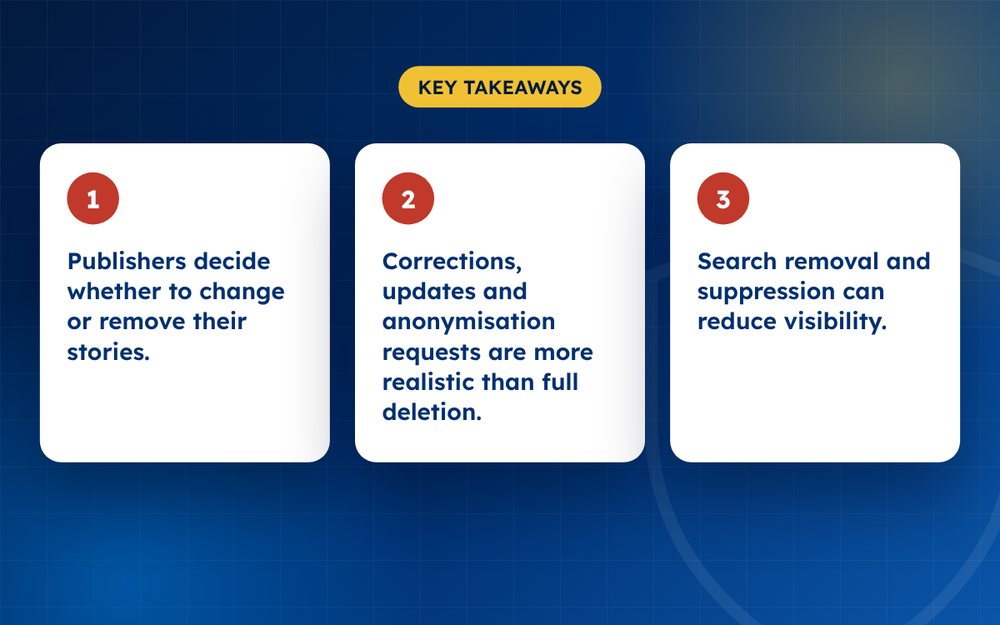
- Publishers decide whether to change or remove their stories.
- Corrections, updates and anonymisation requests are more realistic than full deletion.
- Search removal and suppression can reduce visibility.
What publishers may agree to
- Correcting factual errors
- Updating a story, for example after charges are dropped or a case is resolved
- Anonymising names of private individuals
- Unpublishing in rare cases, such as old minor matters, privacy issues or legal orders
Steps
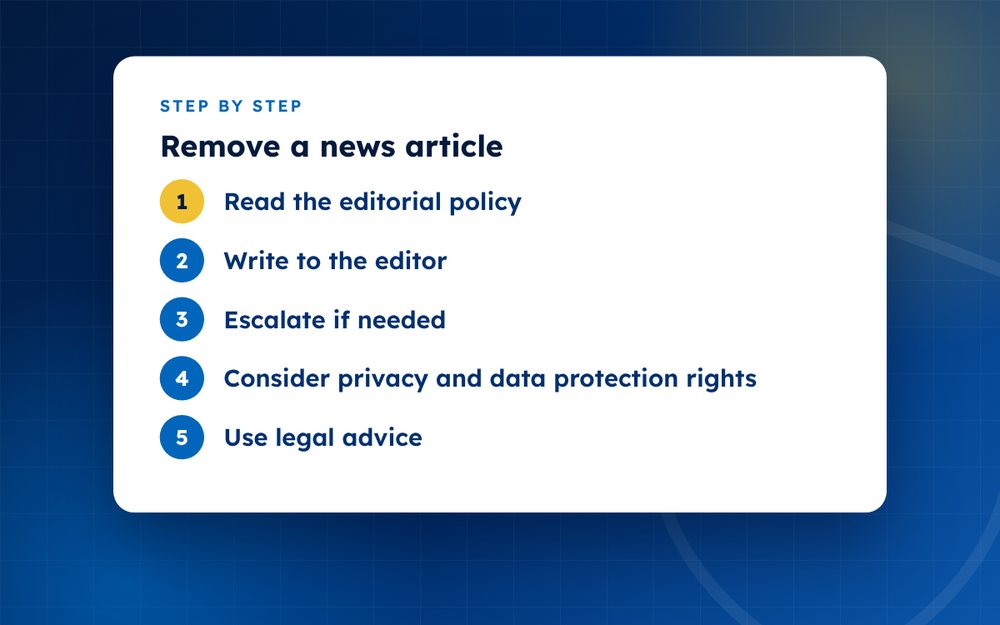
- Read the editorial policyMany outlets publish rules about corrections, updates and unpublishing.
- Write to the editorBe polite, factual and specific. Explain the harm and attach evidence.
- Escalate if neededIf the first contact fails, ask for a senior editor or the readers' editor.
- Consider privacy and data protection rightsIn some regions you can ask publishers or search engines to act on outdated personal data.
- Use legal adviceFor false and damaging statements, a lawyer can advise on correction demands or court orders.
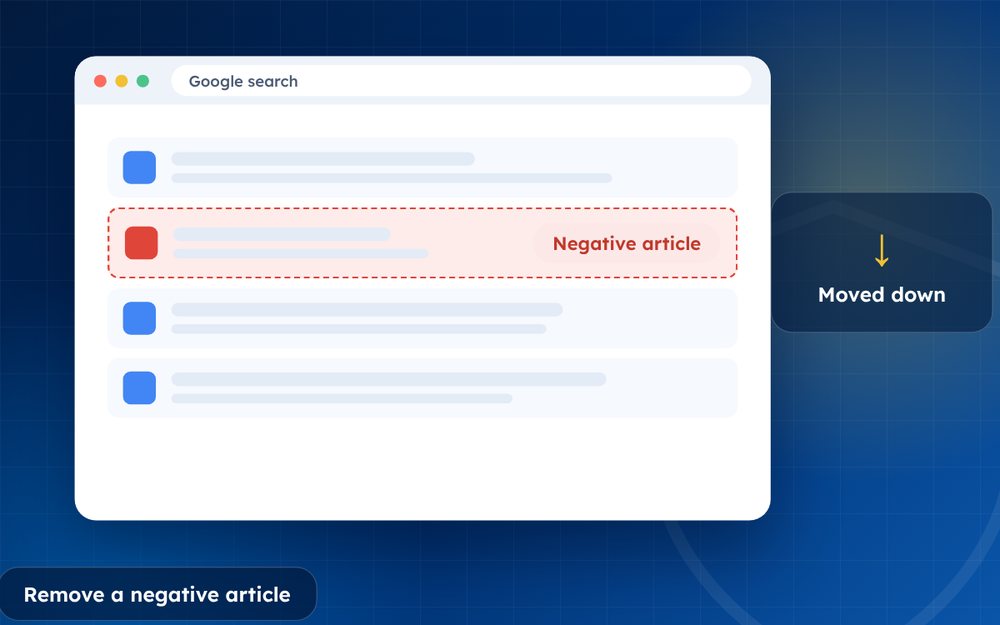
- Reduce its visibilityRequest delisting where applicable and publish stronger accurate content to push it down.
Choosing the right request
- Correction: when a fact is wrong
- Update: when the outcome has changed
- Anonymisation: when you were a private person involved in a minor story
- Unpublishing: when there is a serious privacy or legal reason
- Delisting: when you ask a search engine, not the publisher, to stop showing it
Writing a persuasive request
Be brief and respectful. Include the headline, date and link. Explain what has changed or why the story is wrong. Offer evidence such as a court decision or a letter. State exactly what you would like done, and thank the editor for their time.
What if the publisher refuses?
You can ask for a review by a senior editor, make a complaint to an industry regulator where one exists, or seek legal advice. Keep in mind that taking public action can create new attention. Consider combining your request with suppression work so that the article is less visible.
Alternatives to deletion
If a publisher will not delete a story, there are other ways to reduce harm. An update that explains the outcome of a case, a clarification note or a right of reply can change how the story reads. You can also publish your own account on your website or a trusted platform. Over time, that content can appear alongside the original article.
Be prepared to be patient. These approaches take time, but they often lead to a better result than a confrontation.
Avoid threats or aggressive tactics, which often cause the publisher to defend the story. If you would like an honest assessment, email us the link.
Frequently asked questions
Will a news site delete a true article?
Rarely, but updates, anonymisation and delisting may be possible in some circumstances. Publishers value the public record, so removal is unusual for accurate reporting. A polite request that explains how the story affects you and what has changed can sometimes lead to an update or a change to how your name appears.
Does paying a publisher work?
Not ethically or reliably. Offering money to remove or change a story can be considered improper and may damage your reputation if it comes out. Legitimate options include requesting corrections, updates and anonymisation, or using legal routes where appropriate.
Can Google remove it?
Only in limited cases, such as privacy law, personal information policies or valid legal orders. Even if Google delists a result, the publisher still holds the original article, so it may be found by other means. Combining search removal with a request to the publisher is more effective.
How long does it take?
Weeks to months. Publishers may take time to respond, and legal or privacy processes can be slow. Suppression strategies can take several months to show results. Be patient and keep records of your communications.
Do privacy laws help?
In some countries, they may support a request to update or delist personal information, particularly when it is outdated or irrelevant. The outcome depends on factors such as the public interest and your role. Take local advice before relying on this route.
Should I use a lawyer?
If the story is false and damaging, yes. A lawyer can advise on correction demands and legal action. For minor updates or anonymisation requests, a polite email is often enough. Avoid aggressive legal threats unless you have taken advice.
Need help with this?
Every situation is different. Email us the details in confidence and we will reply with an honest assessment of what can be done.
Contact us by email News Article RemovalThis guide is general information, not legal advice. DMCA Reputation is not a law firm.
Related guides
How to Remove a Negative Article From Google Search
How to remove a negative article from Google search: contact the publisher, use Google's tools and legal routes, or suppress it when removal fails.
Read the guide · 4 min
How to Remove Your Name From Google Search Results
How to remove your name from Google search results: what you can remove, Google's results about you tool, data brokers and what to do about the rest.
Read the guide · 4 min
How to Remove Personal Information From Google (Results About You Guide)
How to remove personal information from Google using the Results about you tool: what qualifies, how to request and how to monitor.
Read the guide · 4 min