
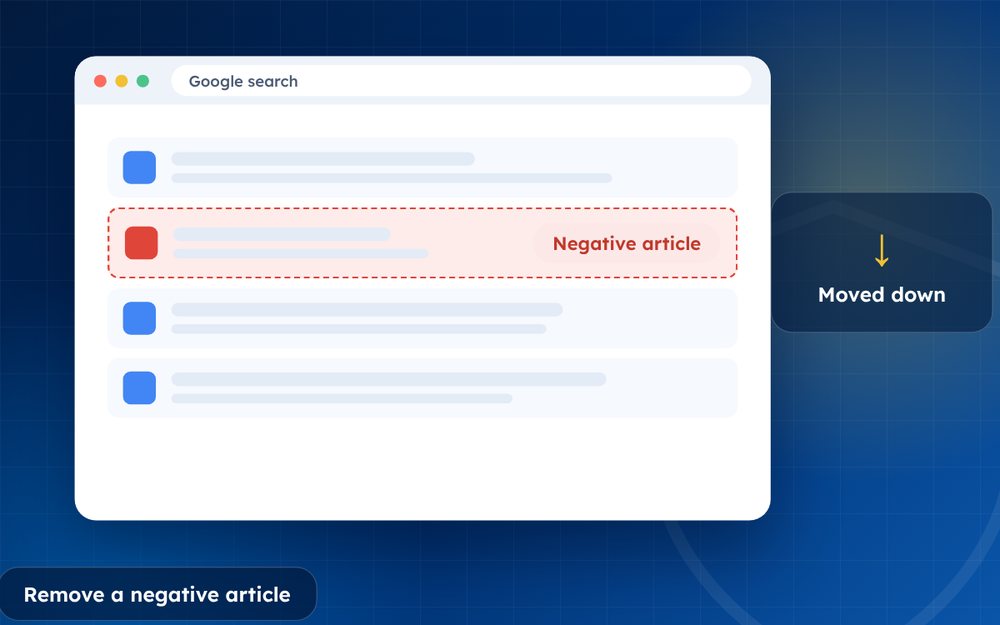
A negative news article or blog post about you or your company can follow you for years because Google keeps showing it. Removing it from search is rarely a single step. The real fix usually starts at the source, with the website that published it.
Many people start by asking how to make Google stop showing an article. The first thing to understand is that Google reflects what is on the internet. If the article remains on the publisher's site, Google can usually still find it, so the most lasting solutions involve the source.
At the same time, there are legitimate ways to reduce how visible an article is in search, and there are cases where Google can remove a result. The right path depends on what the article says, how old it is and where it was published.
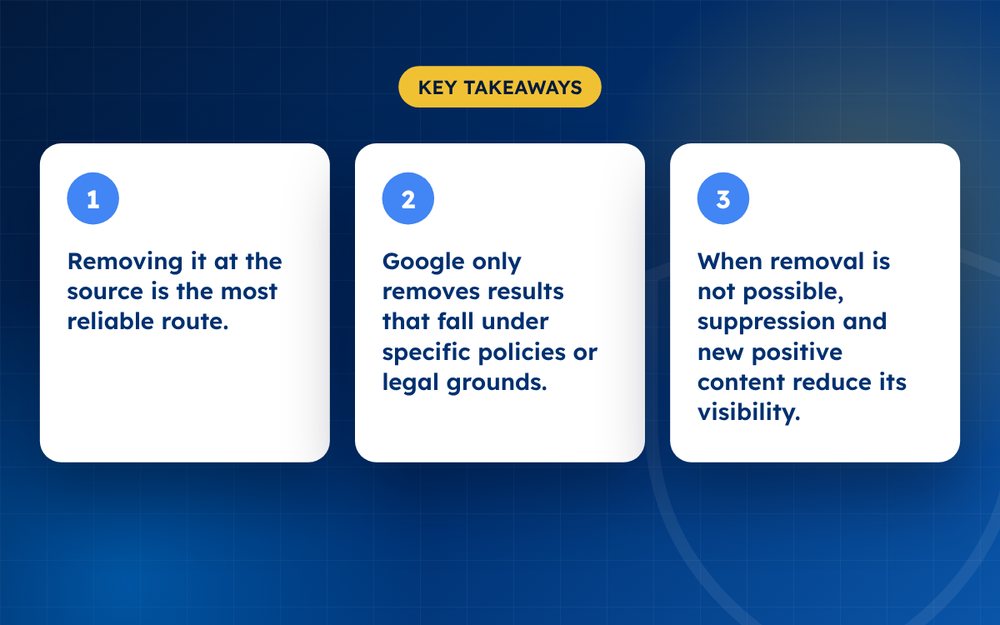
- Removing it at the source is the most reliable route.
- Google only removes results that fall under specific policies or legal grounds.
- When removal is not possible, suppression and new positive content reduce its visibility.
First, understand where the problem sits
Google is a search engine, not the publisher. If the article is still online, it can appear in search again even if Google hides it for a while. Always work out whether you are dealing with the content itself or only how it appears in search.
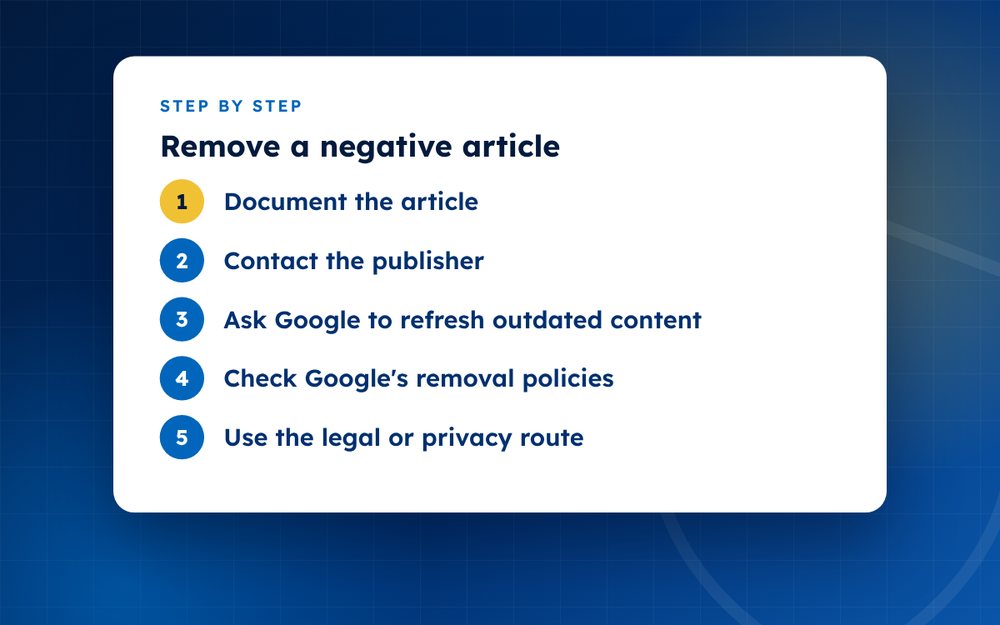
- Document the articleSave the URL, a screenshot, the date and the publisher's contact details. Note exactly what is inaccurate, outdated or harmful.
- Contact the publisherWrite politely to the editor. Ask for a correction, an update, anonymisation or removal and explain why. Many publications update stories when the facts are clearly wrong or the matter has been resolved.
- Ask Google to refresh outdated contentIf the page has changed or been deleted but Google still shows the old version, use Google's outdated content tool to update the result.
- Check Google's removal policiesGoogle removes some results, for example those containing personal contact information, doxxing, non-consensual explicit imagery or certain financial and identity data.
- Use the legal or privacy routeIn the EU, UK and some other places, privacy law lets you ask search engines to delist results. A legal removal request is also possible for some content. A lawyer can advise on suitability.
- Suppress what remainsIf removal is not possible, publish accurate, high quality content that gives searchers a better picture and moves the article down the results.
Questions to ask before you act
- Is the article inaccurate, outdated or incomplete?
- Has anything changed since it was published, such as charges being dropped or a case being resolved?
- Does it include personal details, such as your address or phone number?
- Is it a news article, a blog or a forum post, and who owns the site?
- Do you live in a place where privacy laws allow requests to search engines?
Your answers help decide whether to approach the publisher, Google or both. A story that is clearly false needs a different approach from one that is accurate but old.
Writing to a publisher
The most effective emails are short, polite and specific. State who you are, give the URL, explain exactly what is inaccurate or outdated, attach evidence and say what you are asking for, such as a correction, an update or anonymisation. Avoid threats or accusations. Editors are far more likely to help when they believe you are being reasonable.
If the first email does not work, try the readers' editor or a senior contact. Keep records of all your messages, because they matter if you later need legal advice.
When removal is not possible
If the article is accurate and remains online, you may not be able to remove it. In that case, the practical goal is to reduce its prominence. Publish strong, accurate content about yourself, such as a professional website, profiles and interviews, so that positive results appear alongside or above the article. This takes time, but it often changes what people see.
What does not work
- Threatening the publisher, which often backfires
- Fake accounts or mass reports
- Paying for guaranteed removal from unknown sellers
- Hoping it will fade without action
Be realistic
Accurate reporting of real events is hard to remove. Content that is false, outdated, a privacy violation or published without a valid basis has a better chance. We assess each article honestly before any work begins.
Frequently asked questions
Can Google delete a news article?
Google can remove a result from search in limited cases, such as policy violations, personal information and valid legal requests, but it cannot delete an article from the publisher's website. The page may remain accessible through other routes.
Does removing it from Google remove it from the internet?
No. Removal from search only makes the page harder to find using Google. The article may still be available on the original site, other search engines, social media and archives.
How long does removal take?
It depends on the route. A simple correction might happen within days. Requests to search engines can take days to weeks, and legal processes can take months. Suppression strategies take several months to show results.
What if the article is true?
True reporting is difficult to remove, particularly when it relates to matters of public interest. Depending on your location, you may be able to ask for delisting if the information is outdated or no longer relevant, and you can reduce visibility with new content.
Should I hire a lawyer?
If the article is false and damaging, a lawyer can advise on whether a correction demand or legal action is appropriate. If it is accurate, legal action is unlikely to help and may draw more attention.
Can I ask the publisher to change my name to initials?
Some publishers agree to anonymise names in older stories, especially for minor matters or when the outcome has changed. It is worth asking politely and explaining the impact.
Need help with this?
Every situation is different. Email us the details in confidence and we will reply with an honest assessment of what can be done.
Contact us by email News Article RemovalThis guide is general information, not legal advice. DMCA Reputation is not a law firm.
Related guides
How to Remove a News Article From the Internet
How to remove a news article from the internet: approaching publishers, correction and anonymisation requests, legal grounds and search options.
Read the guide · 4 min
How to Remove Your Name From Google Search Results
How to remove your name from Google search results: what you can remove, Google's results about you tool, data brokers and what to do about the rest.
Read the guide · 4 min
How to Remove Personal Information From Google (Results About You Guide)
How to remove personal information from Google using the Results about you tool: what qualifies, how to request and how to monitor.
Read the guide · 4 min