
A blog or website that attacks your name can seriously harm your reputation. Defamation is a legal concept that varies by country, and not every critical post qualifies. Here is a practical approach.
A website or blog dedicated to attacking you or your business is one of the hardest forms of online harm to deal with. The author may be anonymous, the site may be hosted abroad and the content may be deliberately designed to rank for your name.
Fortunately, there are several layers at which you can act: the platform, the host, the registrar, search engines and, where the content is clearly unlawful, the courts.
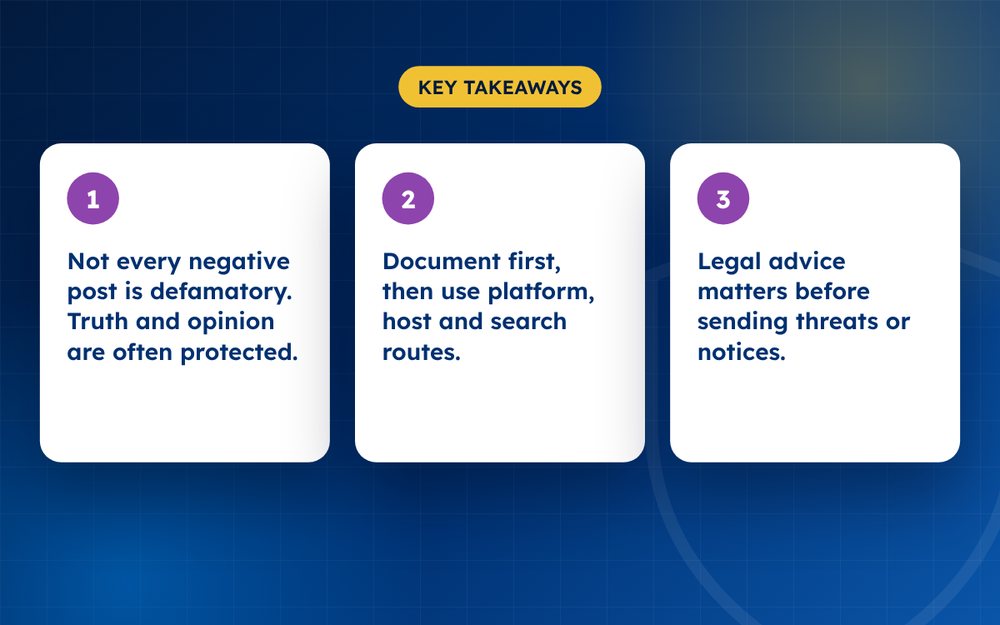
- Not every negative post is defamatory. Truth and opinion are often protected.
- Document first, then use platform, host and search routes.
- Legal advice matters before sending threats or notices.
Is it defamation?
Generally a defamatory statement is a false statement of fact that is communicated to others and causes harm. Opinions, honest criticism and true statements are usually not defamation. The test differs from country to country.
Steps
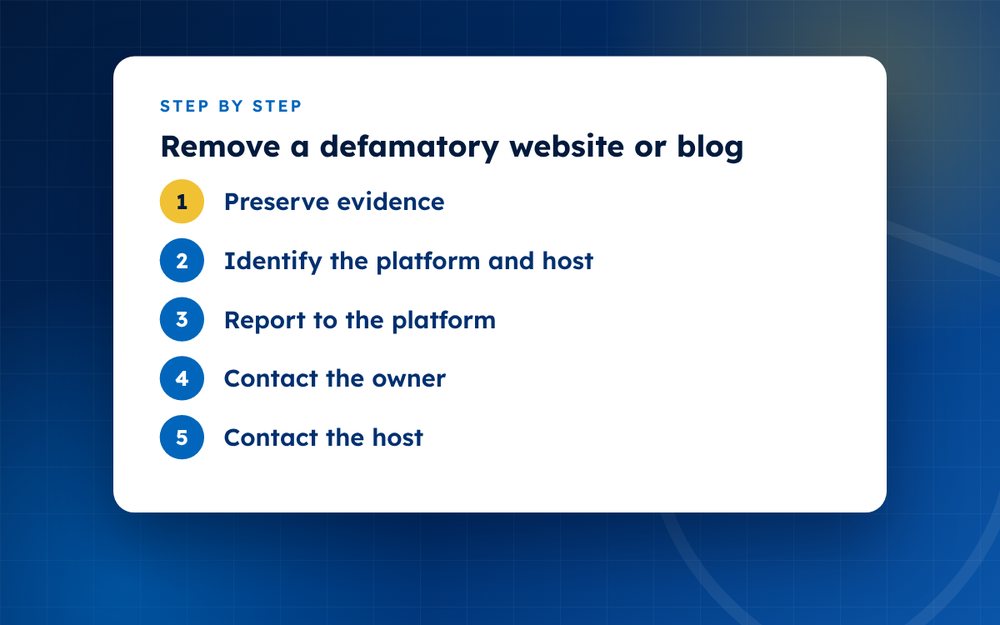
- Preserve evidenceSave the page, URL, date and screenshots. Use an archive tool where helpful.
- Identify the platform and hostFind out whether it is on a platform such as Blogger or WordPress.com, or a self-hosted site.
- Report to the platformMost platforms have policies on harassment, defamation or privacy and a way to report.
- Contact the ownerA calm, factual request for correction or removal sometimes works.
- Contact the hostFor self-hosted sites, send a complaint to the hosting provider and the domain registrar if the content is clearly illegal.
- Take legal adviceA lawyer can advise on a cease and desist, a court order or a platform legal request.
- Request search removal and suppressIf the page stays, use search removal options where they apply and build accurate content.
Separating defamation from criticism
Not everything that is hostile is defamatory. Opinion, satire and honest criticism are generally protected, and in many countries truth is a full defence. Statements that are false, presented as facts and harmful to your reputation are the ones most likely to qualify. Read the post carefully and highlight each specific claim, then note whether you can prove it false. That list will be useful for every request you make.
Using the platform's own rules
If the content is hosted on a platform such as Blogger, WordPress.com or Medium, check its terms. Most prohibit harassment, impersonation, doxxing and sometimes defamation. A report that quotes the specific rule and attaches evidence is more effective than a general complaint. Platforms often act faster on privacy and harassment violations than on defamation, because they can verify them more easily.
Self-hosted sites
- Use a WHOIS lookup to find the registrar and a hosting lookup to find the host
- Send an abuse report to the host that explains which of its terms the site breaks
- Contact the registrar if the site is clearly abusive
- Remember that many hosts respond only to court orders for defamation, but act on copyright, privacy and harassment complaints
Legal action and its limits
A lawyer can send a letter, seek a court order to remove content or ask a court to order disclosure of an anonymous author. These steps can be slow and costly, and they are not always successful, so ask for an honest assessment of the chances and the likely cost before you decide.
While any legal process runs, work on search visibility. Publish accurate, professional content so that the attack site does not dominate the first page for your name.
We are not a law firm and do not give legal advice. We can coordinate the practical work alongside your lawyer. Email us for an assessment.
Frequently asked questions
Can I sue anonymously posted content?
In some countries a court can order a platform or host to disclose information that helps identify an anonymous author, but this is complex, costly and not guaranteed. A lawyer can explain whether your case meets the requirements where you live and whether the likely outcome justifies the expense.
Will Google remove defamatory pages?
Usually only through a legal removal request, and only when your legal claim is clear under local law. Google does not decide whether something is defamatory on its own. A court order is the most reliable basis, so ask a lawyer about whether it is worth obtaining one.
What if it is true?
If the statements are true, removal is very unlikely and a defamation claim would probably fail. Your options become suppression, privacy-based requests where available and building positive content. Consider whether the content is also unlawful for other reasons, such as sharing private information.
How long does it take?
Platform reports can be handled in days. Host and registrar complaints take weeks. Court processes take months or longer. Suppression takes several months to show results. Because the timelines differ, it is common to run several routes at once.
Should I reply publicly to the post?
Usually not. Replying can draw attention and give the author more material. Keep a calm, factual statement on your own website if you need to explain the situation to customers or partners, and let formal processes run in the background.
Is it worth hiring a specialist?
If the attack is persistent, hosted abroad or tied to a competitor, a specialist can coordinate reports, evidence and search work while your lawyer handles legal matters. Ask for a clear scope and be wary of promises of guaranteed removal.
Need help with this?
Every situation is different. Email us the details in confidence and we will reply with an honest assessment of what can be done.
Contact us by email Defamation RemovalThis guide is general information, not legal advice. DMCA Reputation is not a law firm.
Related guides
How to Remove a Negative Article From Google Search
How to remove a negative article from Google search: contact the publisher, use Google's tools and legal routes, or suppress it when removal fails.
Read the guide · 4 min
How to Remove a News Article From the Internet
How to remove a news article from the internet: approaching publishers, correction and anonymisation requests, legal grounds and search options.
Read the guide · 4 min
How to Remove Your Name From Google Search Results
How to remove your name from Google search results: what you can remove, Google's results about you tool, data brokers and what to do about the rest.
Read the guide · 4 min