
Businesses often wonder how far they can go to deal with negative reviews. The legal position depends on your country, but several principles apply almost everywhere. This is general information, not legal advice.
Few questions about reviews are as important, or as misunderstood, as whether it is legal to remove negative ones. The answer depends on how you do it and on what the review says. Using official reporting channels is legal and sensible. Using pressure, payment or deception is risky.
This is general information, not legal advice. Laws differ between countries.
- Reporting reviews that break platform rules is legitimate.
- Paying for removals, faking reviews or pressuring reviewers is risky or unlawful.
- Many countries restrict suppressing genuine customer reviews.
What is generally fine
- Reporting reviews that break a platform's rules
- Replying publicly
- Resolving a customer's problem and asking if they would update their review
- Asking all customers for honest reviews
- Seeking legal advice about defamatory statements
What is risky or unlawful
- Posting fake positive reviews or paying others to
- Offering money or gifts for deleting or changing a review
- Threatening reviewers, or using clauses in contracts to stop honest reviews
- Selectively inviting only happy customers in a misleading way
- Making false copyright or legal claims to force removal
Why it varies by country
Consumer and advertising regulators in many places, such as the EU, UK, US and Australia, have rules or guidance on fake reviews and review suppression. Defamation law also differs widely. Take local advice before relying on legal threats.
A safe approach
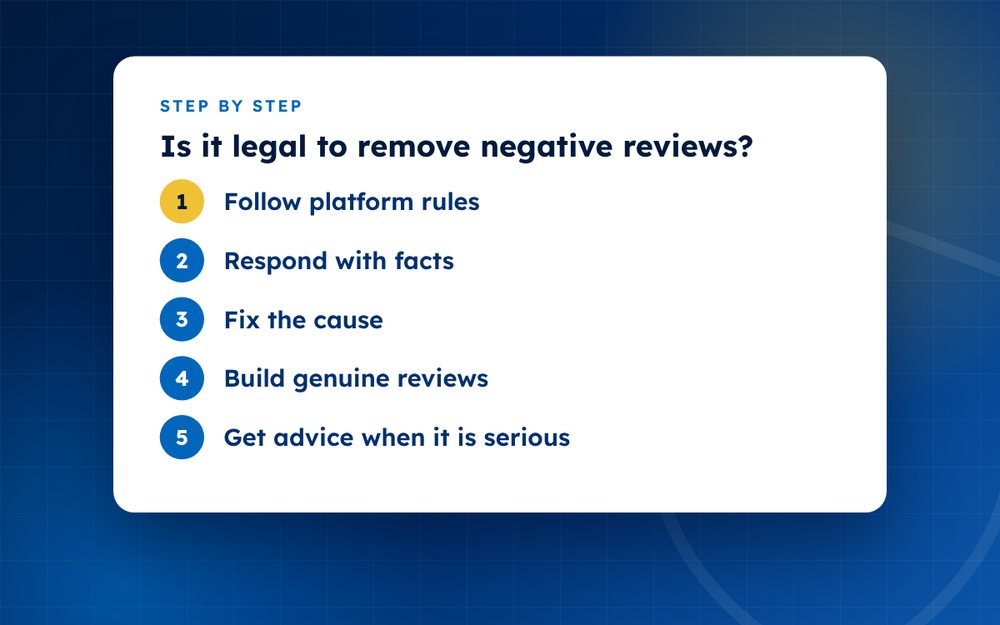
- Follow platform rulesUse official report and appeal routes.
- Respond with factsKeep replies calm and accurate.
- Fix the causeImprove the service behind repeated complaints.
- Build genuine reviewsAsk all customers fairly.
- Get advice when it is seriousA lawyer can help with defamation and cross-border issues.
Why regulators care
Consumer protection bodies in many places treat fake reviews and review suppression as misleading practices. Businesses that remove genuine negative reviews, or manipulate ratings, can face fines and reputational damage. The aim of these rules is to ensure that consumers see an honest picture.
Safe practices
- Report content that breaks platform rules
- Respond publicly and politely
- Resolve genuine complaints
- Ask all customers for reviews, not just happy ones
- Keep records of your actions
Risky practices
- Paying or threatening reviewers
- Writing or buying fake positive reviews
- Hiding genuine negative feedback by pressuring platforms
- Using contract terms to stop honest reviews
- Misusing copyright or legal claims
If you are unsure whether an approach is appropriate, take advice from a lawyer with experience in consumer and advertising law.
Documenting your approach
If a regulator or customer ever asks how you handle reviews, being able to show a clear policy is valuable. Write a short internal guideline that says you ask all customers for feedback, respond to complaints respectfully and only report reviews that break platform rules. Keep records of reports and outcomes.
This protects you from accusations of manipulation and gives your team a consistent approach.
If you are unsure whether an approach is legitimate, email us before acting.
Frequently asked questions
Can I sue over a negative review?
Only if it is defamatory under your local law, which is a high bar. The statement generally needs to be a false statement of fact that causes serious harm. Opinions and genuine experiences are usually protected. Seek legal advice first, because litigation can be costly and can draw more attention to the review.
Can I use a gag clause?
Many countries now restrict clauses that punish customers for leaving honest reviews. In some places they are unlawful or unenforceable. Check the rules where you operate and take legal advice. Using such clauses can damage trust and attract regulatory attention.
Is it legal to ask for reviews?
Yes, when done fairly and openly. You can invite customers to leave reviews, but you should not offer rewards that bias them, ask only happy customers or hide how you collect feedback. Follow platform rules and local consumer protection guidance.
Is it legal to pay for review removal services?
Be careful. Paying to manipulate reviews can break the law and platform rules. Legitimate providers work through official reporting and appeal routes and do not promise guaranteed removal. If someone offers to delete reviews through unofficial methods, avoid them.
What is the safest way to handle bad reviews?
Respond professionally, fix the cause and encourage more genuine reviews. Use official channels to report content that breaks the rules, and keep records of your actions. This approach protects you from legal risk and builds trust with customers.
Do rules differ by country?
Yes. Consumer protection, advertising and defamation laws differ widely. Regulators in the EU, UK, US, Australia and elsewhere have published guidance on fake reviews and review suppression. Check the rules where you operate, and take local legal advice before you act.
Need help with this?
Every situation is different. Email us the details in confidence and we will reply with an honest assessment of what can be done.
Contact us by email Review ManagementThis guide is general information, not legal advice. DMCA Reputation is not a law firm.
Related guides
How to Remove a Google Review: A Complete Guide for Business Owners
How to remove a Google review: what Google will remove, how to report it, how to appeal and what to do if it stays. A guide for business owners.
Read the guide · 6 min
Can You Delete a Google Review? What Google Will and Won't Remove
Can you delete a Google review? Learn who can delete one, what Google removes on request, and what your options are when a review will not come down.
Read the guide · 5 min
How to Report a Fake Google Review, Step by Step
How to report a fake Google review step by step: spotting fakes, flagging from your Business Profile, evidence to gather and what to do if it stays.
Read the guide · 5 min