
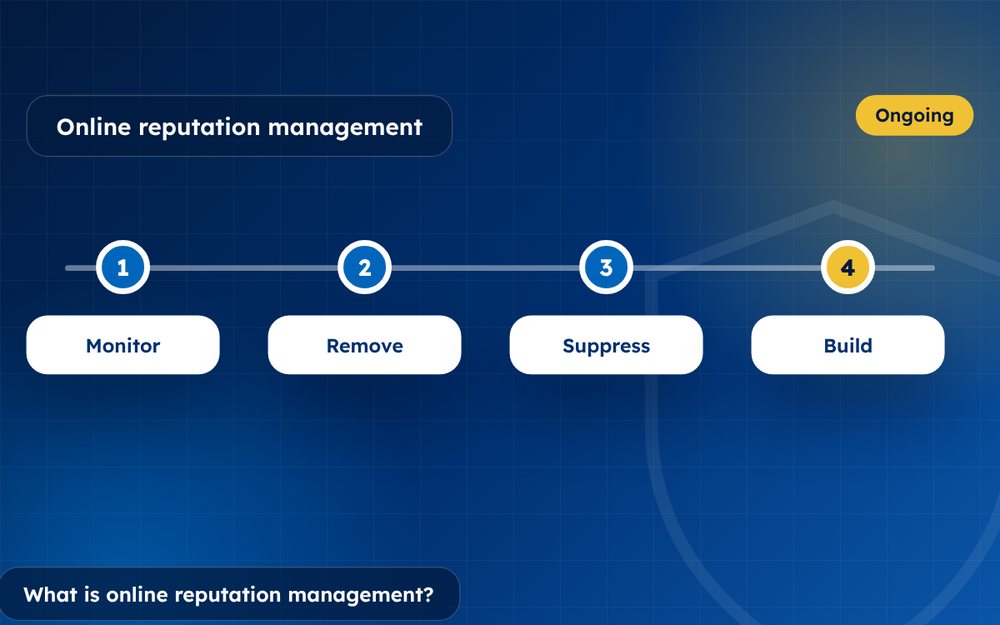
Online reputation management, or ORM, is the practice of shaping how you or your business appear on the internet. When people search for you, read reviews or ask an AI assistant about you, their impressions form quickly. ORM helps make sure those impressions are accurate and fair.
The internet remembers. Reviews, news stories, social posts and forum threads can sit in search results for years, and people make decisions based on what they find in seconds. Online reputation management is the practice of taking an active role in what they see.
It is not a single trick or product. It is a set of habits and services that work together.
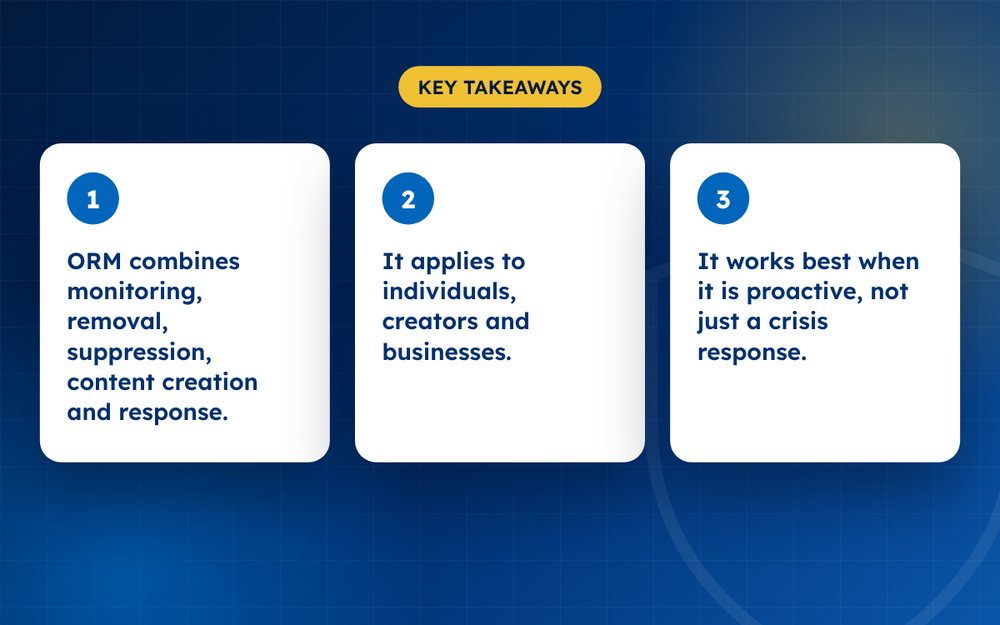
- ORM combines monitoring, removal, suppression, content creation and response.
- It applies to individuals, creators and businesses.
- It works best when it is proactive, not just a crisis response.
The five parts of ORM
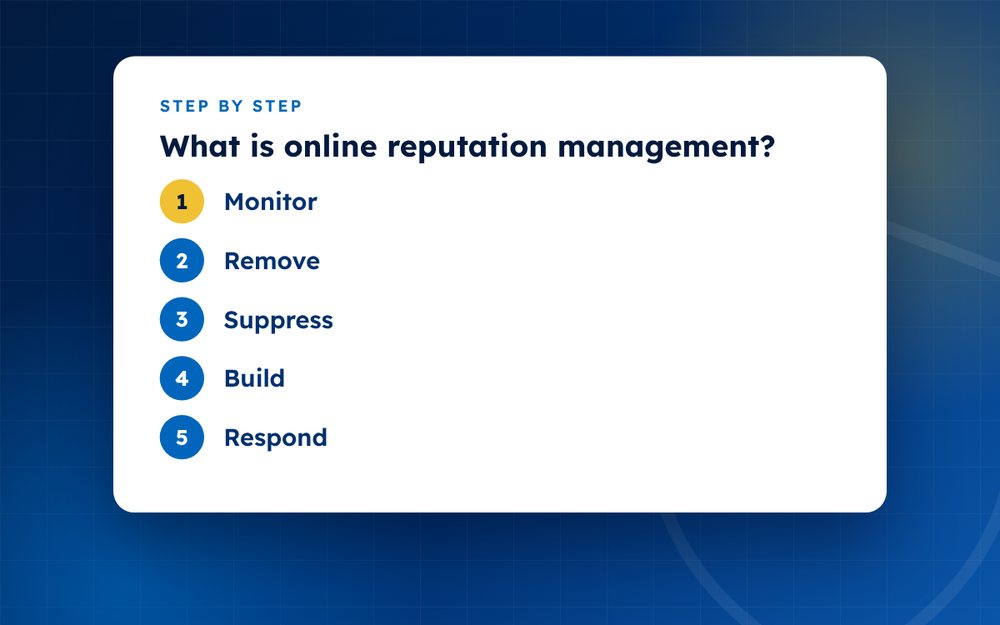
- MonitorTrack what appears about you in search results, social media, review sites and news.
- RemoveAsk platforms and websites to delete content that breaks their rules or the law, such as fake reviews, leaked content, defamation or privacy violations.
- SuppressPush down content that cannot be removed with stronger, accurate content.
- BuildCreate profiles, articles, press and reviews that show your real strengths.
- RespondReply to reviews and criticism professionally and quickly.
How the five parts fit together
Monitoring tells you what is happening. Removal deals with content that breaks rules or the law. Suppression pushes down what cannot be removed. Building creates a strong, positive presence. Responding keeps relationships with customers and the public healthy. Most people need more than one of these at once.
Signs you need ORM
- Your name or business shows unexpected or unfair results
- Negative reviews are affecting sales or hiring
- You have been targeted by harassment, leaks or impersonation
- You are about to launch something and want a strong first impression
- You have a common name and struggle to stand out
What good ORM looks like
A trustworthy provider explains what is possible and what is not, uses legitimate methods, communicates clearly and does not promise guaranteed removal. It focuses on accurate information and long-term improvement.
Doing it yourself or with help
Many tasks, such as searching yourself, setting up alerts and completing your profiles, can be done on your own. A specialist is useful when problems are urgent, complex or sensitive, or when you do not have time to manage them.
Common myths
- Myth: you can pay to delete anything. Reality: platforms and publishers decide, and no one can guarantee removal.
- Myth: ORM is only for scandals. Reality: most of the value comes from steady, proactive work.
- Myth: ignoring problems makes them go away. Reality: unaddressed content can climb in search results.
- Myth: only big brands need it. Reality: a single result can matter more to a small business or an individual.
Who needs it
- Individuals and public figures concerned about what appears in search
- Creators facing leaks, impersonation or harassment
- Businesses with fake, unfair or damaging reviews
- Executives and professionals whose names are linked to old stories
- Law firms supporting clients in settlements and cyber law matters
What ORM is not
It is not hiding the truth or posting fake reviews. Ethical ORM corrects inaccuracies, removes content that breaks the rules and promotes genuine information.
How to start
- Search your name and business in a private window
- List problems and rank them by impact
- Claim your profiles and update them
- Set up alerts for your name
- Get specialist help for serious or complex cases
If you want a clear assessment of your online reputation, email us and we will tell you honestly what can be done.
Frequently asked questions
Is online reputation management legal?
Yes, when it relies on legitimate removal requests, accurate content and honest promotion. Practices such as fake reviews or harassment are not legal and are not part of ethical ORM.
How long does ORM take?
Quick wins, such as reporting policy-breaking reviews, may take days. Rebuilding search results usually takes months. The timeline depends on your starting point, the competition and the types of problems. A good provider gives realistic estimates.
Can ORM guarantee removal?
No ethical provider can guarantee removal because platforms and publishers make the decisions. Honest providers explain the likelihood of success and the alternatives. Be cautious of any promise of guaranteed deletion.
Is it only for big companies?
No. Individuals, creators and small businesses often benefit the most, because a single result can have a large impact. Many ORM tasks, such as monitoring and profile building, are simple and low cost.
What is the difference between ORM and PR?
PR focuses on media relations and communications, often to promote or explain a message. ORM also covers search results, reviews, removals and monitoring, and often works alongside PR. They complement each other.
How much does ORM cost?
It depends on the services you need and the complexity of the situation. A good provider will review your situation first and explain the options before quoting. Be cautious of fixed prices offered without knowing your case.
Need help with this?
Every situation is different. Email us the details in confidence and we will reply with an honest assessment of what can be done.
Contact us by email Brand BuildingThis guide is general information, not legal advice. DMCA Reputation is not a law firm.
Related guides
How to Build a Positive Online Reputation, Step by Step
How to build a positive online reputation step by step: profiles, content, reviews, press and monitoring for individuals and businesses.
Read the guide · 4 min
Personal Branding: How to Build a Strong Personal Brand Online
Personal branding guide: how to build a strong personal brand online with a clear message, a website, profiles and consistent content.
Read the guide · 3 min
How to Optimize Your LinkedIn Profile to Rank on Google
How to optimise your LinkedIn profile to rank on Google: custom URL, headline, About section and public profile settings.
Read the guide · 3 min