
Content removal fails most often because the wrong route was used. Matching the problem to the right request saves time and avoids rejection.
Different problems need different routes. Copyright covers content you created. Defamation covers false statements of fact that harm reputation. Privacy covers personal information and intimate content. Platform policies cover harassment, impersonation and scams.
This is general information, not legal advice. Laws differ by country, so check local rules.
Many removal requests fail because they use the wrong label. A platform that is willing to remove stolen content may not act on a complaint of defamation, and the reverse is also true.
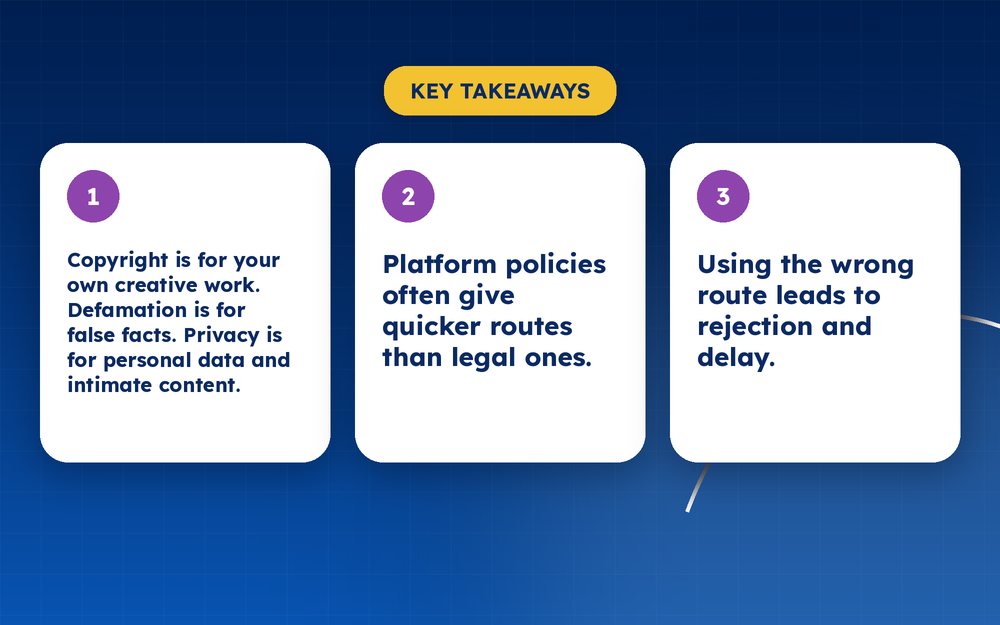
- Copyright is for your own creative work. Defamation is for false facts. Privacy is for personal data and intimate content.
- Platform policies often give quicker routes than legal ones.
- Using the wrong route leads to rejection and delay.
How to choose, step by step
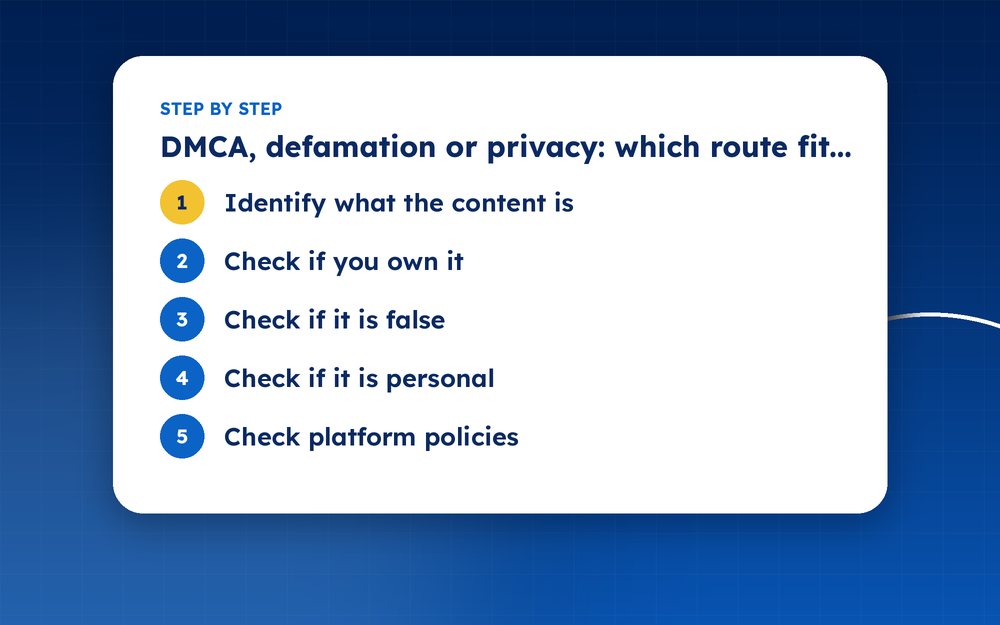
- Identify what the content isIs it your work, a statement about you, personal data or an intimate image? Describe the content in one sentence. Is it your work, a false statement, private information or something else?
- Check if you own itIf you created it, copyright is likely the best route. If you created the content, copyright may be the strongest route, and notices are processed formally.
- Check if it is falseIf it states false facts about you, consider defamation or platform rules on false claims. If the content states false facts about you, defamation may apply, but proving falsity and harm can be hard and slow.
- Check if it is personalIf it shows personal data or intimate imagery, use privacy and non-consent routes. If it reveals private details, such as your address, images or documents, privacy routes may be quicker.
- Check platform policiesMany platforms have specific rules for harassment and impersonation. Each platform has rules about copyright, harassment, privacy and false information. Choose the one that matches.
- Choose the strongest routePick the route with the clearest fit and the least cost. Pick the route most likely to succeed and fastest, and consider using more than one where appropriate.
- Prepare evidenceMatch your evidence to the route. Gather the proof that route needs: originals for copyright, evidence of falsity for defamation, and proof of identity for privacy.
Copyright route
Use it when the content copies your original work. Notices go to the site, host and search engines. It is structured, fast and does not require proving harm.
Defamation route
Defamation concerns false statements of fact that harm reputation. It is complex and varies by country, and removal often needs a court order. Platforms may act under policy on harassment or false claims without a court order. Speak to a lawyer for serious cases.
Privacy and non-consent routes
Personal data, intimate images and doxxing are covered by platform privacy policies, search engine forms and sometimes data protection law. These routes can be fast for clear cases.
Combining routes
Some cases fit more than one route. A photo of you taken and posted by someone else may involve copyright, privacy and harassment. Use the clearest one first, and add others if needed.
What a typical case looks like
A photographer finds a site using her photo with a false caption. She could argue defamation, but copyright is clearer. She sends a copyright notice with her original file and the site removes the photo within three days. She then reports the false caption on a social platform under its rules, with a short statement.
Using the clearest route first got faster results than arguing about the falsehood.
Common mistakes to avoid
Do not claim copyright for content you do not own. Do not call every negative post defamation. Do not ignore platform policies. And do not skip evidence.
How a specialist can help
A specialist team can assess your situation, choose the right route and handle the notices. We are not a law firm and cannot give legal advice. Email us in confidence.
Frequently asked questions
Which route is fastest?
Often copyright for stolen content and privacy for private data, because platforms have set processes. Defamation is usually slower.
Can I use more than one route?
Often yes, if each applies and your claims are accurate.
What if none fits?
Consider platform policies on harassment or misinformation, and ask a lawyer about other options.
Do I need evidence for all routes?
Yes, but the kind differs. Match it to the claim.
Is it wise to use legal threats?
Usually not at first. They can backfire. Start with formal reports.
Is this legal advice?
No. It is general information, and laws differ by country. For advice on your situation, speak to a qualified lawyer.
Need help with this?
Every situation is different. Email us the details in confidence and we will reply with an honest assessment of what can be done.
Contact us by email DMCA takedown serviceThis guide is general information, not legal advice. DMCA Reputation is not a law firm.
Related guides
GDPR Erasure Request: Template and Steps
GDPR erasure request template and steps: who can use it, how to write a request, what to expect, deadlines and what to do if a company refuses. General information.
Read the guide · 4 min
UK Online Safety Act: How It Helps With Removal
UK Online Safety Act: how it helps with removal of harmful content, what platforms must do, how to report and what the regulator can and cannot do. General information.
Read the guide · 3 min
How to Send a DMCA Takedown Notice (With Template)
How to send a DMCA takedown notice: what to include, who to send it to, a free template, counter-notices and common mistakes.
Read the guide · 5 min