
Many people ask whether they can take legal action against someone who shared their intimate images. In many places there are options, but this is a question for a lawyer. Here is a general overview.
We are not a law firm and cannot give legal advice. This page explains in general terms how legal routes work, so you know what to ask. The right answer depends on where you live, where the other person lives and the facts.
It is also worth knowing that removal does not require legal action. Many people get content taken down through platform reports and search engine requests without ever going to court, and may talk to a lawyer later if they want to claim compensation.
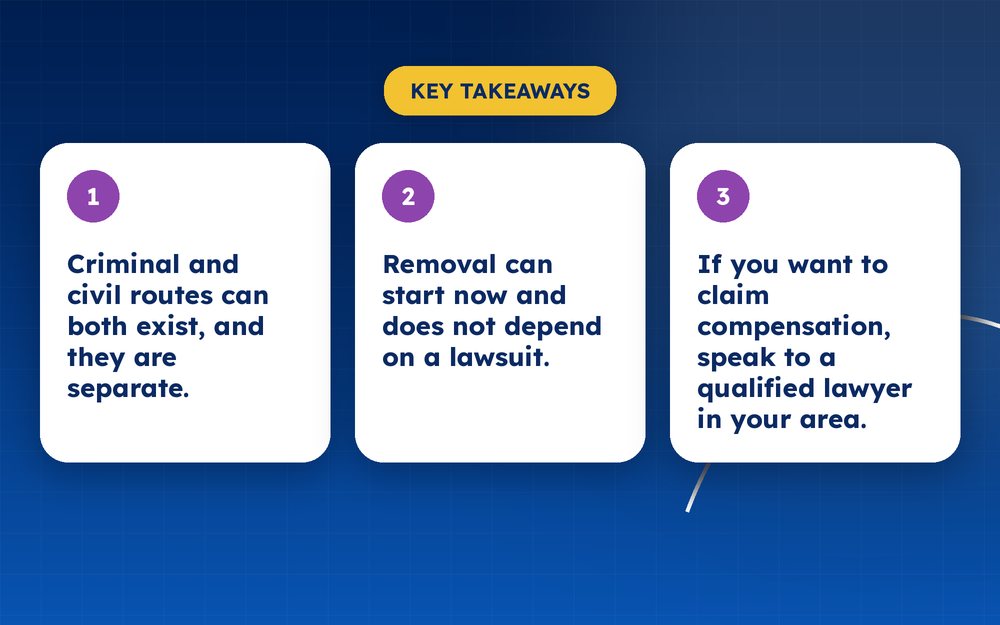
- Criminal and civil routes can both exist, and they are separate.
- Removal can start now and does not depend on a lawsuit.
- If you want to claim compensation, speak to a qualified lawyer in your area.
How to think about it, step by step
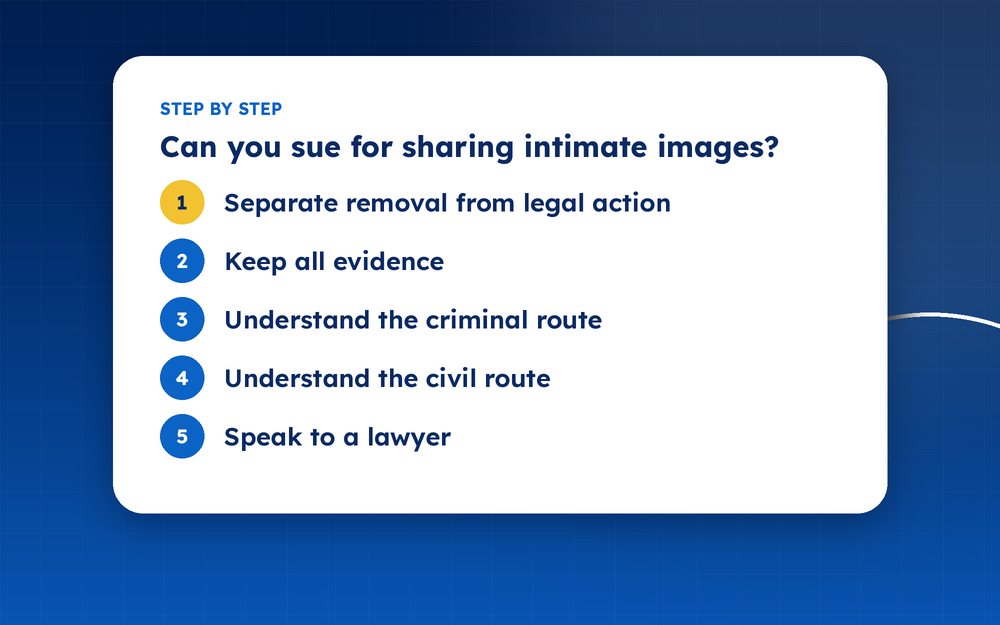
- Separate removal from legal actionStart with removal, which is faster and cheaper. Legal action is a separate decision. Removal can happen quickly through platforms. A legal claim is a separate decision that takes more time and money.
- Keep all evidenceSave links, screenshots, messages and dates, which any legal route will need. Save everything, including messages, links, screenshots and records of how it affected you.
- Understand the criminal routeThe police can investigate in many places. A prosecution is decided by the authorities, not by you. In many places, sharing intimate images without consent is a crime. The police can explain what is possible.
- Understand the civil routeIn a civil case, you may be able to ask a court for damages or an order. This usually needs a lawyer. A civil claim, such as for privacy or emotional distress, may be possible in some places. A lawyer can explain.
- Speak to a lawyerAsk about your options, costs, timing and the chances in your place. Some offer free first consultations, and some charities offer support. A lawyer can advise on costs, chances, privacy and risks, and whether a claim fits your aims. You can contact us for a recommendation if you want one.
- Keep protecting yourselfContinue to report, monitor and look after your wellbeing while any process continues. Whatever you decide, keep removing copies and improving your privacy.
What a lawyer can help with
A lawyer can explain whether you have a claim, who could be responsible, which court is suitable and what it may cost. They can also send formal letters and, in some cases, apply for court orders requiring content to be removed or identities to be disclosed.
These are legal decisions, and they depend on the details of your case.
What removal services can do without court
Specialists can find copies, report them to platforms and hosts, and ask search engines to remove links. These routes do not require proof of a legal claim, though evidence helps. Sometimes this is enough to get the content down without any legal action.
If you later choose to claim compensation, you can talk to a lawyer, and you can contact us if you would like a recommendation. We do not promote particular law firms in our guides.
Costs and timing
Legal action can take months or longer and may involve costs. Some places have support schemes or specialist charities. Ask up front about fees and likely timeframes so you can decide what suits you.
A note on anonymity and safety
Some people worry that going to court means their private images being discussed in public. Many places have rules that protect victims' identities or allow hearings to be restricted. Ask a lawyer how privacy is handled in your location before you decide.
What a typical case looks like
A woman wants to know whether she can sue an ex-partner who shared her images. She starts removal immediately, saves evidence and reports to the police. A lawyer explains the criminal and civil routes, the cost and the chances. She decides to pursue the police report and keep the civil option open.
Taking advice separated the urgent task of removal from the longer legal decision.
Common mistakes to avoid
Do not delay evidence collection while deciding. Do not pay for legal services that guarantee outcomes. Do not contact the other person in a way that could cause problems later without advice.
How a specialist can help
If you want to keep legal options open while dealing with the content, a specialist team can handle removal and keep records that help later. We are not a law firm and cannot advise on claims, but we can handle the practical side and talk honestly about what is realistic. Email us in confidence.
Frequently asked questions
Can I get compensation?
In some places, yes, through a civil claim. Whether it is possible in your case is a question for a lawyer.
Do I need to sue to get content removed?
No. Platform reports and search engine requests work without legal action.
What if I do not know who shared it?
Some legal routes allow identifying anonymous users. A lawyer can explain.
Is going to the police the same as suing?
No. Police action is criminal and handled by the authorities. A civil claim is brought by you.
How much does it cost?
It varies widely. Ask for a clear estimate and about any free or low-cost support.
Will you recommend a lawyer?
If you want to take that step, contact us and we can discuss it. We do not promote lawyers in our guides.
Need help with this?
Every situation is different. Email us the details in confidence and we will reply with an honest assessment of what can be done.
Contact us by email NCII removalThis guide is general information, not legal advice. DMCA Reputation is not a law firm.
Related guides
How to Help a Friend Whose Intimate Images Were Leaked
How to help a friend whose intimate images were leaked: what to say, what not to do, how to help with reporting and removal, and how to look after yourself too.
Read the guide · 4 min
What to Do If Intimate Images From When You Were Under 18 Are Online
What to do if intimate images of you from when you were under 18 are online: report to NCMEC and police, use Take It Down, stop spread and get support. Calm guidance.
Read the guide · 4 min
How to Remove Non-Consensual Intimate Images (NCII), Step by Step
How to remove non-consensual intimate images (NCII): reporting, StopNCII.org, Google removal, legal options and support. A step-by-step guide.
Read the guide · 4 min