
If images of you from when you were a child or teenager are online, you are a victim and you are not in trouble. There are dedicated routes to get them taken down quickly, and support to help you through it.
Images of under-18s of this kind are treated as child sexual abuse material in many countries, and platforms and authorities act with particular urgency. Whether you are still under 18 or an adult looking back, specific reporting routes exist.
You do not need to look at the images to report them, and you should not share them with anyone, even to ask for help.
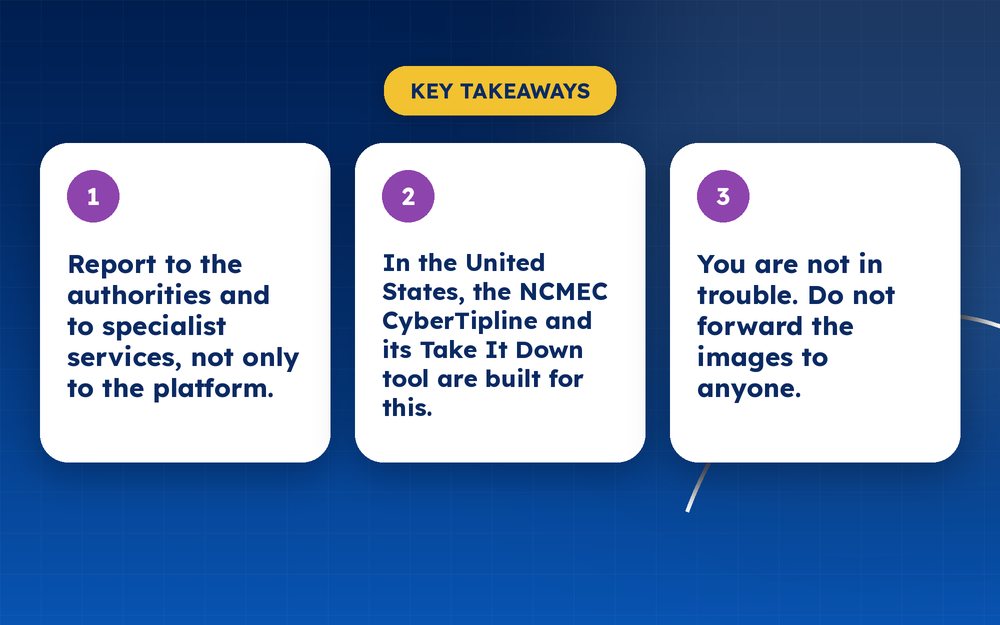
- Report to the authorities and to specialist services, not only to the platform.
- In the United States, the NCMEC CyberTipline and its Take It Down tool are built for this.
- You are not in trouble. Do not forward the images to anyone.
If you need support now
If you are overwhelmed or thinking about harming yourself, contact your local emergency number or a crisis line immediately. You can also tell a trusted adult. Support is available, and this can be dealt with.
What to do, step by step
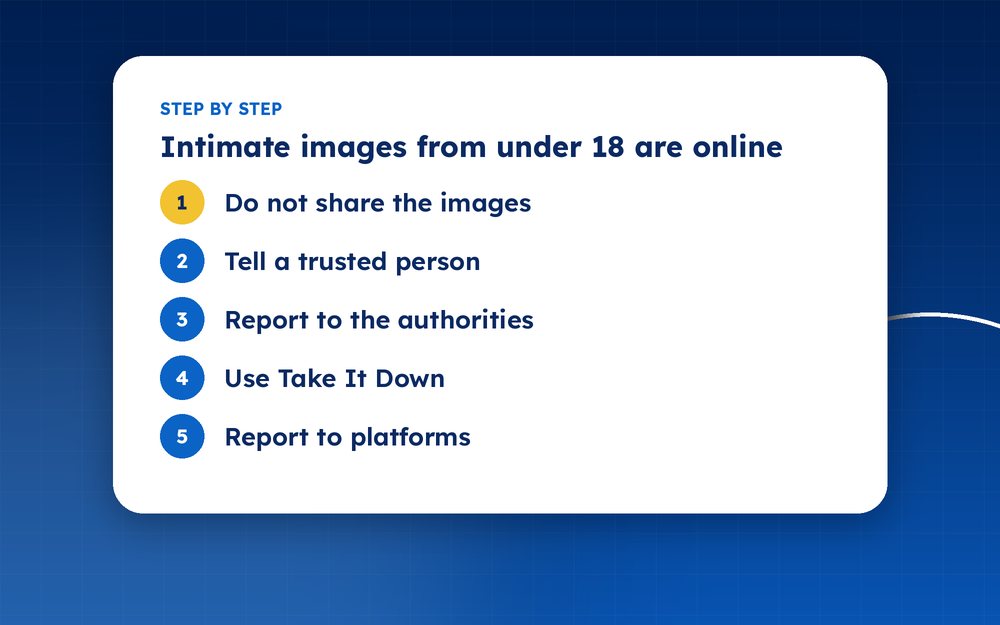
- Do not share the imagesDo not forward them to anyone, including friends or officials. Reports can be made with links and descriptions. Do not forward, save or share the images, even to show someone. Sharing them can be an offence.
- Tell a trusted personA parent, carer, teacher, doctor or counsellor can help you. If you are an adult, a friend or support service can. Tell a trusted adult, such as a parent, teacher or counsellor. You are not in trouble for asking for help.
- Report to the authoritiesContact the police, and in the US use the NCMEC CyberTipline. Other countries have their own hotlines and child protection bodies. Report to the police or the relevant child protection authority. They have specific routes for this.
- Use Take It DownNCMEC's Take It Down tool can help remove images made when someone was under 18, and creates a fingerprint without you sending the image. Take It Down is a service for people under 18 or adults with images from when they were under 18, to help remove images from participating platforms.
- Report to platformsUse the report option and choose the category for child sexual abuse material or nudity involving minors. Use the platforms' report tools and choose the options for child safety or non-consensual content.
- Ask search engines to remove linksSearch engines have specific processes for this kind of content. Ask search engines to remove results that link to the images.
- Get supportTalk to a counsellor or support service, whatever your age. Talk to a counsellor or support service. You deserve support.
If you are under 18 now
Tell a trusted adult as soon as you can. You will not be punished for being a victim. Authorities and specialist organisations focus on stopping the spread and finding who is responsible. If someone is pressuring you for more images or money, do not reply and tell an adult or the police.
If you are an adult and the images are from childhood
You can still report, and the same routes apply. Services like NCMEC can help adults whose images were made when they were under 18. You can also work with police and support organisations, and you may choose to talk to a counsellor who has experience with this.
Why specialist routes matter
Platforms and hotlines handle this content under strict rules, and reports often get faster handling than ordinary requests. Because the content is illegal to share, it should not be passed around, even to prove a point.
What happens after you report
Specialist bodies and platforms review the report, remove content where they can and, where appropriate, pass information to law enforcement. You may be contacted for more details, and you can ask a support person to be with you.
Removal for this kind of content is usually faster and more thorough than for other cases, and many people are relieved to see how seriously it is taken.
What a typical case looks like
A young adult learns that an image from when she was 16 has been posted online. She does not share or save it, tells a trusted friend and reports to the police. She uses the Take It Down service and reports to the platform and the search engine. The platform removes the image and she receives support from a counsellor.
Reaching out quickly and not forwarding anything kept her safe from further harm.
Common mistakes to avoid
Do not download or forward the images. Do not confront the person alone. Do not delay out of shame. And do not pay anyone who threatens to share the images.
How a specialist can help
Specialist support can help with searching for copies, reporting them to the right bodies and monitoring, while you work with the authorities. Because of the sensitivity of this content, we work only with links and descriptions and never ask you to send images. Email us in confidence.
Frequently asked questions
Am I in trouble for images from when I was a minor?
No. Victims are not the ones at fault. Authorities focus on the people who share or exploit the images.
Do I have to send the images to report them?
No. Links and descriptions are usually enough, and tools like Take It Down work without you sending the image.
Who do I report to in the United States?
The NCMEC CyberTipline and your local police, plus the platform itself.
What if I am an adult now?
You can still report. The same routes apply, and support services can help.
Can the images be removed from search?
Search engines have processes for this content. Submit requests with links.
Who can I talk to?
A trusted adult, a counsellor, or a specialist helpline.
Need help with this?
Every situation is different. Email us the details in confidence and we will reply with an honest assessment of what can be done.
Contact us by email NCII removalThis guide is general information, not legal advice. DMCA Reputation is not a law firm.
Related guides
How to Stop Intimate Images Reappearing After Removal
How to stop intimate images reappearing after removal: hash matching, monitoring, search alerts, quick re-reporting and what you can realistically expect.
Read the guide · 4 min
What to Do in the First 24 Hours After Intimate Images Are Shared Without Consent
What to do in the first 24 hours after intimate images are shared without your consent: stay safe, save evidence, report fast and get support. A calm checklist.
Read the guide · 6 min
How to Remove Non-Consensual Intimate Images (NCII), Step by Step
How to remove non-consensual intimate images (NCII): reporting, StopNCII.org, Google removal, legal options and support. A step-by-step guide.
Read the guide · 4 min