
A rejection is not always the end. Many requests fail for fixable reasons, such as missing information or the wrong route. Here is how to read a rejection and decide what to do next.
Platforms and search engines reject requests that do not meet their policies or lack key details. Some rejections are automated, others are reviewed by people.
Read the reason carefully, then decide whether to resubmit, appeal or use another route.
Most rejections come from a handful of fixable causes. If you read the message calmly and check your request against it, you can often resolve the issue with one corrected submission.
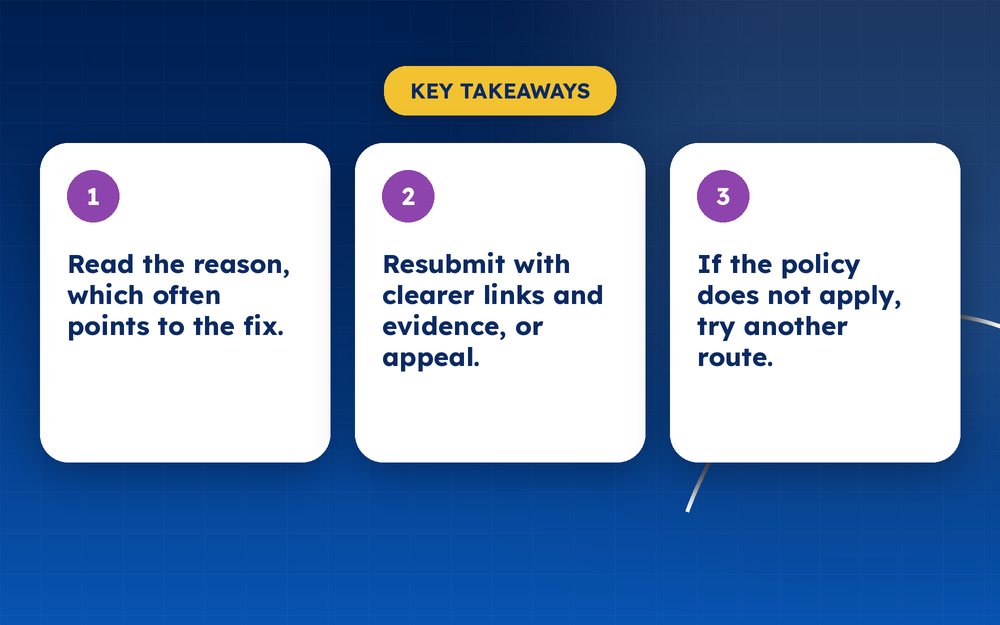
- Read the reason, which often points to the fix.
- Resubmit with clearer links and evidence, or appeal.
- If the policy does not apply, try another route.
What to do next, step by step
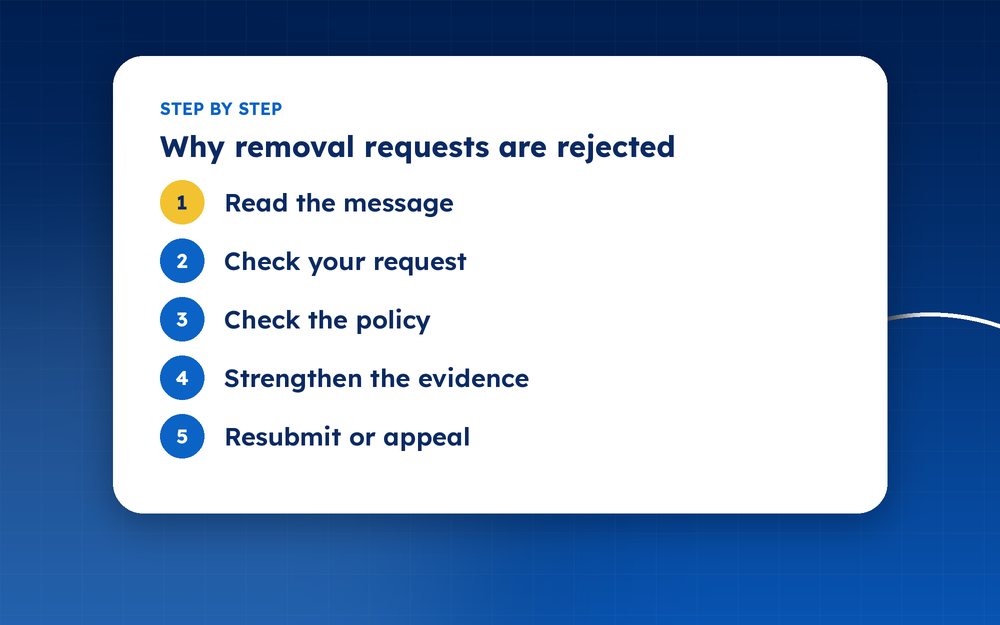
- Read the messageNote the reason and any suggestions. Copy the reason and any suggestions. Short automated messages still contain clues, such as "link not found" or "does not violate policy".
- Check your requestLook for missing links, wrong URLs or vague descriptions. Check that each web address is correct, still works and points to the exact page. Missing details and typos cause many rejections.
- Check the policyConfirm whether your case fits. Read the platform's policy for your type of request. If your case does not match it, you need a different route.
- Strengthen the evidenceAdd proof of ownership, dates or context. Add proof of ownership, dates or screenshots that show the issue clearly. Keep the explanation short.
- Resubmit or appealFollow the platform's process. Follow the platform's appeal or resubmission steps. Quote the first reference number and address the reason given.
- Try another routeUse copyright, privacy, legal or host routes if suitable. A copyright problem may need a notice, a privacy problem may need a personal information request and a false statement may need a legal route. Choose the route that fits.
- Keep recordsNote dates and responses. Record the date, reference and response of each attempt. It helps you, a service or a lawyer see what has been tried.
Common reasons
Typical reasons include links that no longer work, content that is not covered by the policy, missing proof of ownership, unclear descriptions and requests that should have used a different form.
Appeals
Some platforms allow appeals with extra information. Keep the appeal short and focused on the reason given.
Changing route
If the policy does not cover your case, another route may. For example, a copyright issue may need a notice instead of a privacy request. A legal route may be needed for defamation. Consider advice if unsure.
When to stop
If the content is lawful, public and accurate, removal may not be possible. In that case, focus on context, visibility and building positive content.
What a typical case looks like
A person reports a page as harassment and is rejected. She reads the message and sees that the page only contains her photo, not abuse. She realises that the issue is that her photo was used without consent, so she resubmits under the platform's image privacy route with proof that it is her. The second request is accepted.
The first rejection was not a verdict on her case. It was a sign she had chosen the wrong category.
Common mistakes to avoid
Do not resend identical requests. Do not ignore the reason. Do not use threatening language. And do not give up before checking other routes.
How a specialist can help
A specialist team can review a rejection, strengthen your request and choose the next route. We cannot promise success, but we will be honest about what is realistic. Email us in confidence.
Frequently asked questions
Can I resubmit a rejected request?
Yes, usually with improvements. Fix the issue named in the rejection, and do not simply resend the same request.
Is a rejection final?
Not always. Many platforms allow appeals or new requests with more information.
Should I contact support?
Where a support option exists, a short polite message can clarify the reason.
What if the content is lawful?
It may not be removable. Focus on context, search visibility and building positive content.
Can a different route help?
Often. The same content may be removable under copyright, privacy or other policies.
Is this legal advice?
No. It is general information. For legal routes, speak to a qualified lawyer.
Need help with this?
Every situation is different. Email us the details in confidence and we will reply with an honest assessment of what can be done.
Contact us by email How it worksThis guide is general information, not legal advice. DMCA Reputation is not a law firm.
Related guides
How Long Does a DMCA Takedown Really Take?
How long does a DMCA takedown really take? Typical timelines for platforms, hosts and search engines, what slows things down and how to speed it up.
Read the guide · 4 min
Does a DMCA Notice Work on Overseas Pirate Sites?
Does a DMCA notice work on overseas pirate sites? Why some comply, why many ignore notices, and how upstream providers and search removal fill the gap.
Read the guide · 4 min
How Much Does Review or Content Removal Cost?
How much does review or content removal cost? What drives the price, how providers charge and questions to ask before hiring.
Read the guide · 3 min