
A DMCA notice is a US legal tool, so you might expect it to fail abroad. In practice, it works against some overseas sites and not others, and other routes fill the gap.
Many overseas sites use US-based infrastructure, such as hosts, content delivery networks or payment providers, which respond to DMCA notices. Others use hosts in countries with weak enforcement and ignore notices.
Search engines also honour notices regardless of where the site is based, which cuts traffic to even the most resistant sites.
The mistake many people make is judging a pirate site only by the country it appears to be in. What matters is every service it relies on: the servers, the domain name, the content delivery network, the advertising and the payment tools. Each of them has its own rules and its own contact, and many are based in countries where notices carry weight.
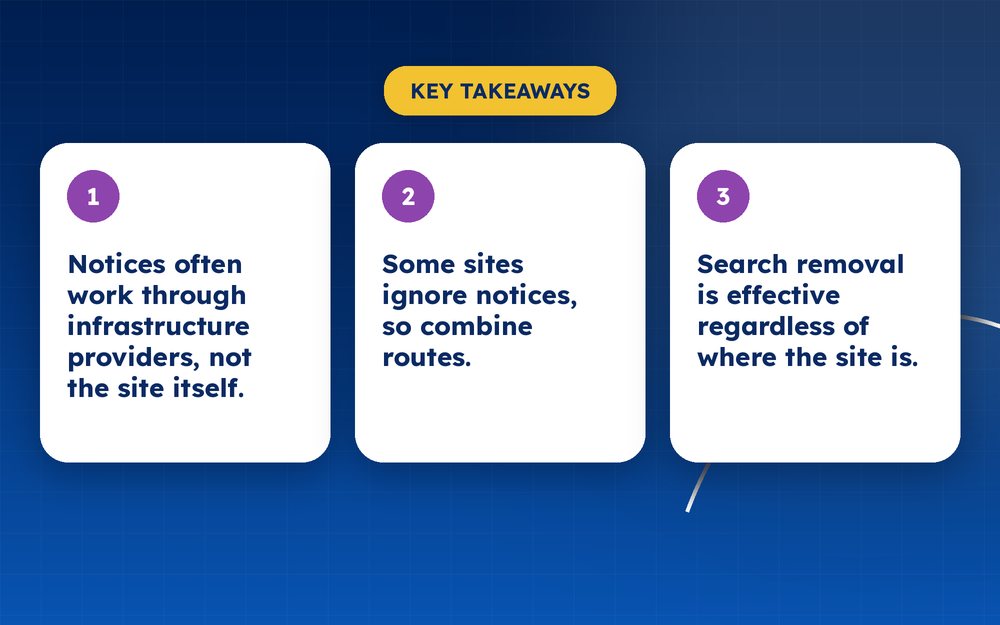
- Notices often work through infrastructure providers, not the site itself.
- Some sites ignore notices, so combine routes.
- Search removal is effective regardless of where the site is.
How to approach it, step by step
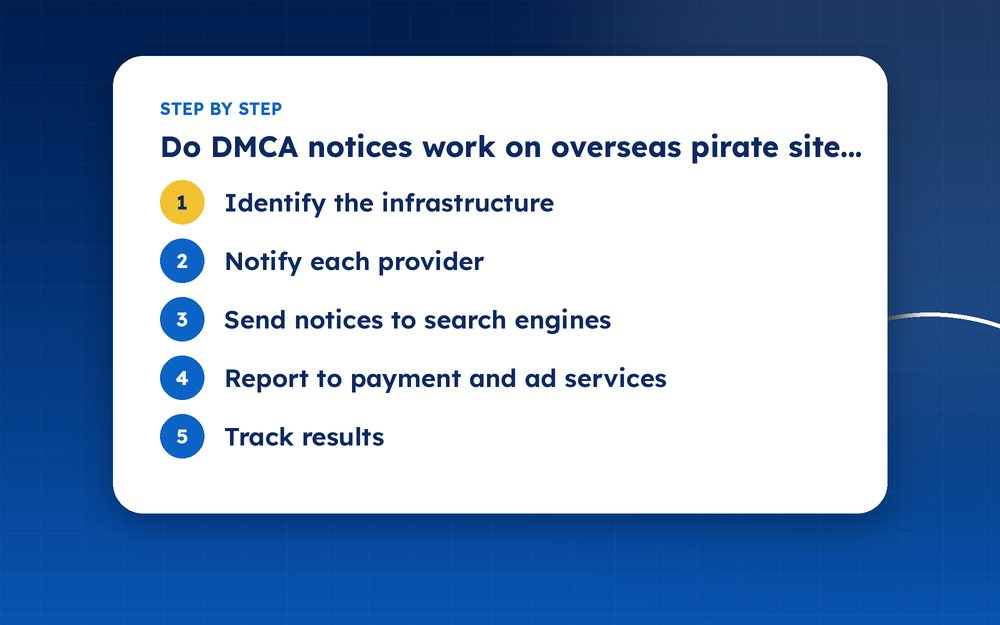
- Identify the infrastructureFind the host, CDN, registrar and payment providers. Use public lookup tools to find the host, the nameservers, the registrar and any content delivery network. Record each name and its abuse or copyright contact.
- Notify each providerSend notices to the ones with copyright policies. Send a separate, complete notice to each provider with a copyright policy. Different providers respond differently, so do not assume one reply covers everything.
- Send notices to search enginesRequest removal of the pirate pages. Search engines respect notices regardless of where a site is based. Submit the page addresses so they stop appearing in results.
- Report to payment and ad servicesCut revenue where you can. Pirate sites often rely on ads and donations. Reporting them to ad networks and payment services can reduce the money they earn and sometimes cuts them off.
- Track resultsRecord which providers acted. Keep a table showing each provider, the date of notice, the response and what changed. It shows which routes work for your content.
- Look for local routesSome countries have their own procedures. Some countries have their own procedures, such as court orders requiring local internet providers to block sites. A lawyer can tell you whether this is realistic.
- Keep monitoringSites move and return. Pirate sites often reappear on new domains. Search regularly for your title and send new notices quickly.
Why infrastructure matters
A pirate site needs servers, DNS, CDN and often payment services. Many of these providers have rules against infringement and act on notices, even if the site owner does not.
When notices fail
Some hosts abroad do not respond to foreign notices. In those cases, upstream providers and search removal may be the best option. Legal action abroad is often costly and uncertain.
Local laws and routes
Some countries have their own copyright takedown procedures or court routes. A lawyer can advise on whether they are practical for your case.
Setting expectations
You may not remove every overseas site, but you can usually reduce visibility and traffic significantly.
What a typical case looks like
A course creator finds her programme offered on an overseas site that ignores emails. She traces the site to a content delivery network with a copyright form, a hosting provider with an abuse address and a registrar. The network suspends service after her notice, the host removes the files after a second notice and the search engine drops her listed pages. The site then appears on a new domain, which she reports the same way within a week.
She did not beat the site once. She made it slow, costly and hard to find.
Common mistakes to avoid
Do not give up after one ignored notice. Do not forget upstream providers. Do not skip search removal. And do not assume a site is untouchable.
How a specialist can help
A specialist team can trace infrastructure, send notices to every layer and monitor for new domains. We are not a law firm and cannot give legal advice. Email us in confidence.
Frequently asked questions
Do overseas sites have to follow the DMCA?
The law itself is American, but many overseas sites use American companies or providers that follow it. Sites that do not respond can often be reached through the services they rely on.
What if the host is in a country that ignores notices?
Use other layers such as the content delivery network, registrar, ad services and search engines. Each can reduce the site's reach even if the host does nothing.
Will search engines remove overseas pirate pages?
Yes. Search engines process notices for pages wherever they are hosted, which reduces the number of people who find them.
Can I sue an overseas site?
It is often costly and uncertain, and it can be hard to identify the operator. A lawyer can advise whether it is realistic for your case.
How long does this take?
Responsive providers may act within days, while others take weeks or never respond. Expect staged results and keep monitoring.
Is this legal advice?
No. It is general information. For court action abroad, speak to a qualified lawyer.
Need help with this?
Every situation is different. Email us the details in confidence and we will reply with an honest assessment of what can be done.
Contact us by email How it worksThis guide is general information, not legal advice. DMCA Reputation is not a law firm.
Related guides
How Pay-Only-on-Removal Works and What to Ask Before Hiring
How pay-only-on-removal works and what to ask before hiring: what counts as removal, how results are verified, hidden terms and questions to protect yourself.
Read the guide · 4 min
Can Anyone Guarantee Content Removal?
Can anyone guarantee content removal? Why honest providers cannot promise outcomes, what they can commit to, and how to spot unrealistic claims.
Read the guide · 4 min
How Much Does Review or Content Removal Cost?
How much does review or content removal cost? What drives the price, how providers charge and questions to ask before hiring.
Read the guide · 3 min