
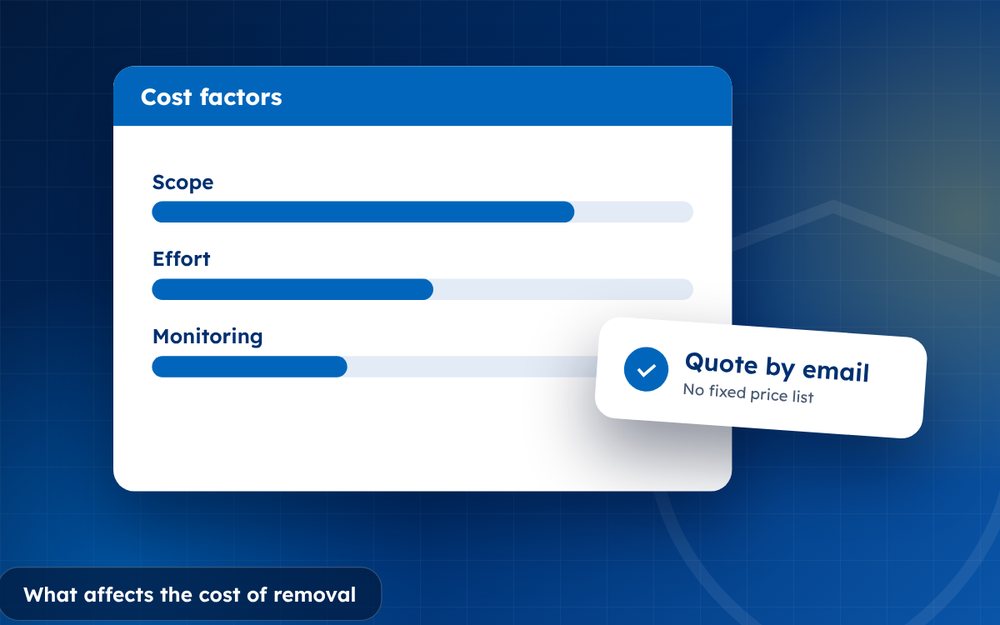
Prices vary widely, and anyone quoting without seeing your case should be treated with caution. What matters is understanding what drives the cost and how a provider charges.
It is natural to ask what removal will cost before you start, but it is also the question that is hardest to answer honestly in general. Two cases that look similar on the surface can need very different amounts of work. That is why reputable providers want to see your situation before they quote.
What you can do is understand what drives the cost, so that you can judge whether a proposal makes sense.
- The cost depends on the type, number and difficulty of items.
- Ask how the provider charges and what happens if removal fails.
- Be wary of guarantees.
What drives the price
- The type of content, such as reviews, articles or leaks
- The number of URLs or listings
- The platform's rules and how hard it is to deal with
- Whether legal work is needed
- Whether monitoring continues afterwards
Ways providers charge
- Per item removed
- Fixed project fees
- Monthly retainers for monitoring
- Success based fees for some services
Questions to ask
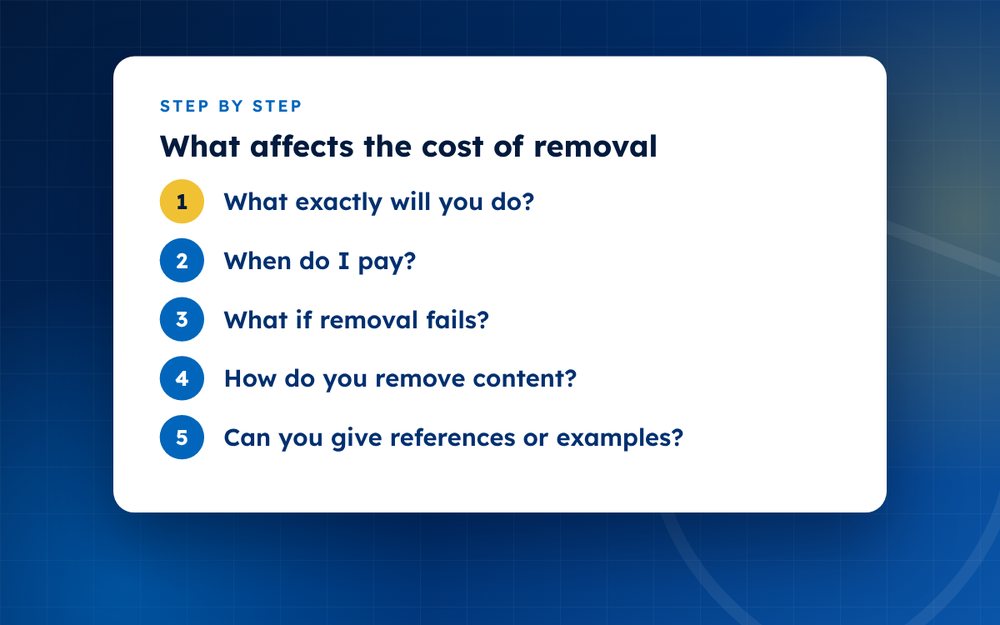
- What exactly will you do?Get a clear scope.
- When do I pay?Understand whether payment depends on results.
- What if removal fails?Ask about refunds.
- How do you remove content?Beware of anything that sounds unethical.
- Can you give references or examples?Ask for evidence of experience.
How providers charge
- Per item: a price for each review, link or profile removed
- Per project: a fixed scope for a defined problem
- Retainer: a recurring fee for monitoring and ongoing work
- Success-based: payment linked to results, with clear terms
- Hybrid: a mix of upfront assessment and results-based fees
Why the same task can differ
A review that clearly breaks a platform's rules may be removed with a single, well-prepared report. A review that does not may need appeals, legal letters or a different strategy altogether. Content hosted on a cooperative site is easier than content on a site that ignores notices. Multiple copies, urgent deadlines and sensitive cases add work.
What to ask about
- What exactly is included, and what is not
- How you will be updated and how often
- What happens if the content cannot be removed
- Whether there are extra costs for appeals, legal work or monitoring
- How long the work is likely to take
- How the provider keeps your information confidential
Red flags in pricing
Be careful with providers who quote a price without knowing your case, who demand full payment upfront with no written scope, who promise guaranteed removal or who refuse to explain their methods. A good provider is open about the limits of what is possible.
Before you commit
Ask for a written summary of the proposed work, including what is covered and what is not. Check how changes of scope are handled. Ask whether there are limits on the number of requests, whether appeals are included and whether monitoring continues after the initial work. Keep a copy of the agreement and any updates.
Clear expectations at the start prevent disputes later and help you judge whether you are getting value.
We reply to enquiries by email with a clear quote after reviewing your case. Contact us to get started.
Frequently asked questions
Why will no one give a fixed price up front?
Because cases differ widely. The right price depends on the type of content, the platform, the number of items and the work needed. A provider who quotes without reviewing your case may be guessing or planning to add costs later.
Is cheaper better?
Not necessarily. Very cheap services may rely on tactics that do not work or that put you at risk. Compare what is included, the provider's experience and the terms, not only the headline figure.
Is pay on success fair?
It can be, when the terms are clear. Make sure you understand what counts as success, how it is verified and whether there are other fees. Success-based models should not push providers to use risky methods.
Can I do it myself?
Many simple cases, yes. Reporting policy-breaking reviews and filing standard takedown requests are tasks you can do. Specialists help with complex, urgent or high-volume cases.
Should I pay for monitoring?
If you are at risk of repeated attacks or leaks, ongoing monitoring can be worth it. Otherwise, a simple routine of your own may be enough.
How do I compare quotes?
Ask each provider to describe the scope, process, timeline and terms in writing. Check what is excluded. Choose the one you trust most and that gives clear answers.
Need help with this?
Every situation is different. Email us the details in confidence and we will reply with an honest assessment of what can be done.
Contact us by email Our servicesThis guide is general information, not legal advice. DMCA Reputation is not a law firm.
Related guides
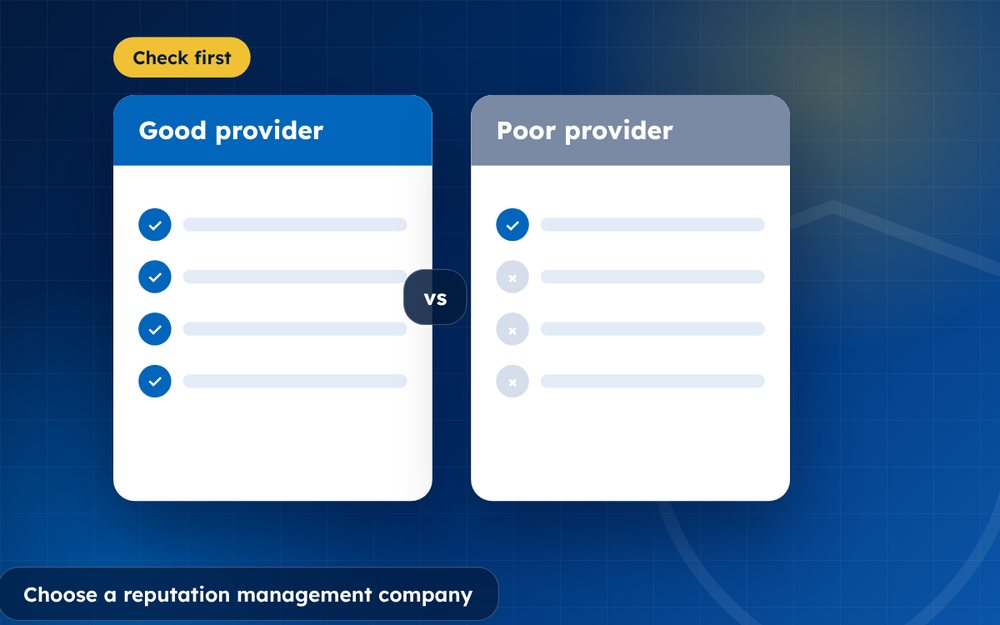
How to Choose a Reputation Management Company
How to choose a reputation management company: what to check, questions to ask, red flags and what ethical providers do.
Read the guide · 3 min
Removal Scams and Red Flags: How to Avoid Them
Removal scams and red flags: how fake removal services work, warning signs and how to protect yourself.
Read the guide · 3 min
Is Online Reputation Management Worth It?
Is online reputation management worth it? Honest factors to weigh, when it pays off and when you can handle things yourself.
Read the guide · 3 min