
Scammers often use a real face, and sometimes a deepfake voice, to make a fake ad look like an endorsement. If it is yours, you can report it, warn your audience and get it removed.
Fake ads using the likeness of creators, doctors, business people and celebrities promote scams, such as investment schemes, miracle products or fake giveaways. Victims lose money, and the person pictured loses trust.
The response needs to protect people who may be deceived, and to clear your name. Start by reporting quickly, then warn your audience clearly.
These ads often use real photos or fake videos of well-known or trusted people, and they run for a short time before disappearing and returning under new names. Reporting each version helps, and so does warning people who trust you.
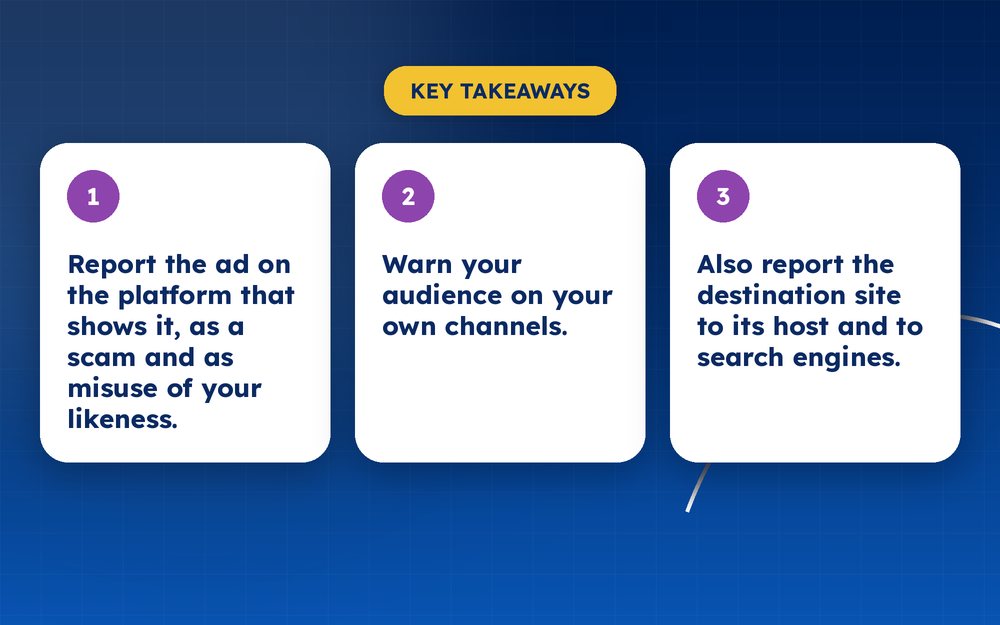
- Report the ad on the platform that shows it, as a scam and as misuse of your likeness.
- Warn your audience on your own channels.
- Also report the destination site to its host and to search engines.
What to do, step by step
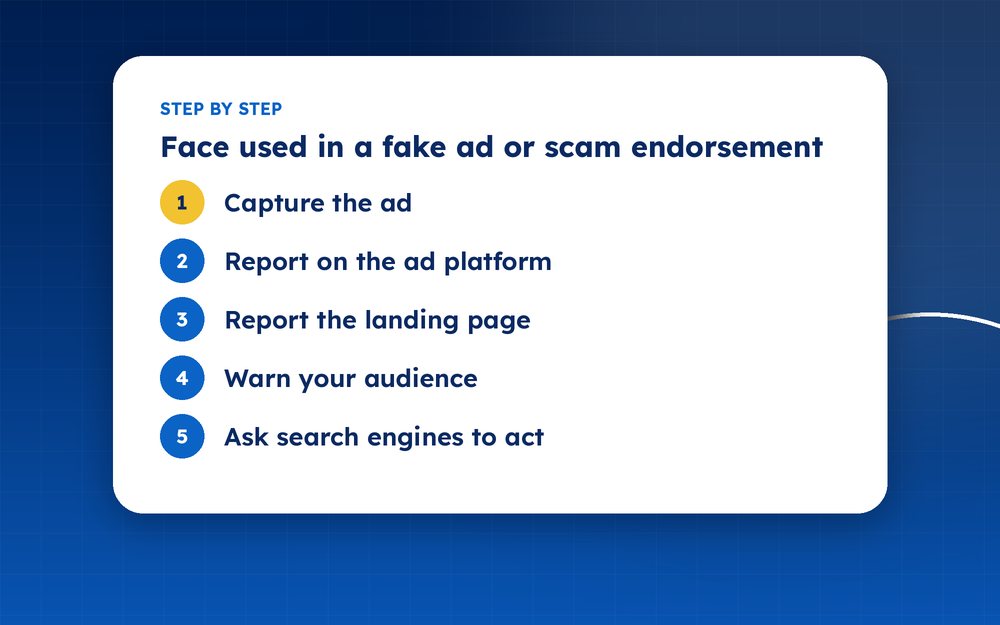
- Capture the adScreenshot the ad, the page it leads to and the account running it. Copy the links. Save the ad, the page it leads to, the account that paid for it and the date. Screenshot every version you see.
- Report on the ad platformUse the report option on the ad for scams, impersonation or misuse of likeness. Use the ad platform's report option for scams and impersonation. Say that the ad uses your image without permission.
- Report the landing pageFind the host of the destination site and send a notice about the scam and misuse of your image. Report the landing page to its host and registrar, and any payment provider it uses.
- Warn your audiencePost that the ad is fake, that you do not endorse it, and how to report it. Post a short notice on your channels that you do not endorse any such product, and how people can verify you.
- Ask search engines to actReport scam sites that appear in search, and ask for removal of pages that misuse your name. Ask search engines to remove links to the landing pages if they appear in results.
- Contact the police and consumer bodiesFraud reports can lead to action, and help protect others. Report to the police and consumer protection bodies, especially if people lost money.
- Monitor for new adsScam ads often reappear with new accounts. Set alerts and re-report quickly. Search regularly for your name with words like investment, offer and promotion. Report new ads quickly.
Writing your warning
Keep it short and factual. Say that ads using your face or voice for a product are fake, that you do not promote it, and that people who paid should contact their bank and report the scam. Link to your official channels so people can check.
Why platforms sometimes miss it
Fake ads are placed by many accounts and change quickly, so a single removal may be followed by new ones. Reporting each ad with a clear statement that it misuses your likeness, and escalating to the platform's brand protection or advertiser support routes where they exist, tends to help.
Legal angles in plain terms
Misuse of your likeness may breach privacy, publicity, fraud or consumer laws, depending on where you are. We are not a law firm and cannot give legal advice. If you want to explore a claim, speak to a lawyer, and you can contact us if you would like a recommendation.
What a typical case looks like
A well-known doctor is shown in an ad endorsing a miracle supplement. A patient sends him a screenshot. He saves the ad, reports it for impersonation and posts a notice that he endorses no products. He reports the landing page to the host. The platform removes the ad within three days and bans the account. Two weeks later, a new version appears, and he reports it using the same evidence.
Warning his audience limited harm while reports were processed.
Common mistakes to avoid
Do not engage with the scammers. Do not share the ad to warn people without a clear caution, since that spreads it. Do not wait for the platform alone. And do not ignore reports from victims, who can help with evidence.
How a specialist can help
When fake ads keep appearing, a specialist team can monitor, report ads and landing pages and send notices to hosts. We cannot promise every ad will vanish, but we will be honest about what is realistic. Email us in confidence.
Frequently asked questions
Can fake ads using my face be removed?
Yes, ad platforms remove scam ads and impersonation when reported, though new ones may appear.
How do I warn people?
Post a short notice on your official channels saying you do not endorse the product, and how to check.
Should I contact the police?
If people lost money, yes.
Can I stop it permanently?
Not completely, but you can reduce it with monitoring.
Can I claim compensation?
That is a legal question. Speak to a lawyer.
Is this legal advice?
No. It is general information, and laws differ by country. For claims or court action, speak to a qualified lawyer.
Need help with this?
Every situation is different. Email us the details in confidence and we will reply with an honest assessment of what can be done.
Contact us by email Deepfake removalThis guide is general information, not legal advice. DMCA Reputation is not a law firm.
Related guides
How to Protect Your Photos From Being Used for AI Nudes
How to protect your photos from being used for AI nudes: privacy settings, sharing habits, watermarks, monitoring and what to do fast if a fake appears.
Read the guide · 4 min
What to Do If Someone Made an AI Nude of You
What to do if someone made an AI nude of you: save evidence, report the fake, remove it from platforms and search, and get support. A calm, practical guide.
Read the guide · 5 min
How to Remove Deepfakes of Yourself
How to remove deepfakes of yourself: documenting evidence, platform reports, search removal and legal options for AI-generated fake images and videos.
Read the guide · 4 min