
When someone threatens to share your private photos unless you pay, panic pushes you to pay and make it stop. In almost every case, paying is the wrong move. Here is why and what to do instead.
Blackmail works because it makes the victim feel there is no other choice. In reality, the person making the threat has little to gain by deleting anything after being paid, and a lot to gain by asking again.
Official advice from police and child protection groups is consistent: do not pay, save evidence, stop contact and report. This page explains the reasoning and the practical steps.
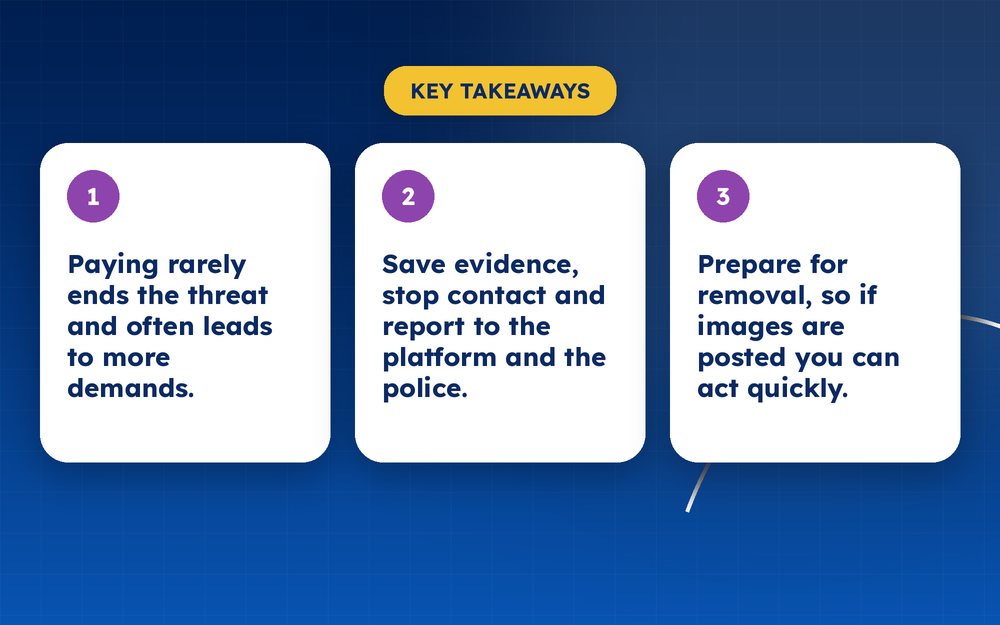
- Paying rarely ends the threat and often leads to more demands.
- Save evidence, stop contact and report to the platform and the police.
- Prepare for removal, so if images are posted you can act quickly.
What to do instead of paying
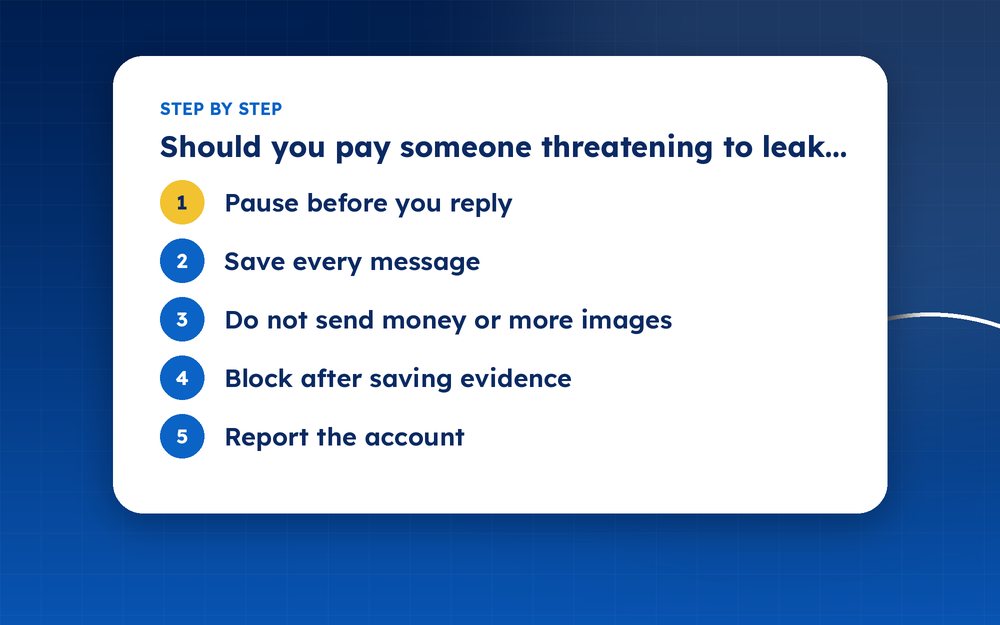
- Pause before you replyThreats are designed to make you act fast. Take a few minutes, or ask a trusted person to help you think. Give yourself a few minutes before you reply. Panic is what blackmailers rely on.
- Save every messageScreenshot the threats, the account, the payment demands and any deadlines. Store them privately. Take screenshots of every message, account and payment demand. Do not delete anything.
- Do not send money or more imagesEach payment or image gives the person more power. Say nothing further. Payment rarely ends it. Sending more images gives the person more material. Avoid both.
- Block after saving evidenceStop contact once you have captured the messages. Once you have saved the evidence, block the account and any linked ones.
- Report the accountUse the platform's report tools and mention blackmail. Report the account to the platform for blackmail or extortion.
- Contact the policeBlackmail is a crime in many places. Provide your evidence and ask what steps they recommend. Report to the police and, if you are under 18, to child protection services. They can advise on next steps.
- Prepare your response planKnow how you would report and remove content if it appears: platform reports, search engine requests and a trusted helper. Prepare a plan for removal in case images are posted, and tell a trusted person what is happening.
Why paying usually fails
A person who is willing to threaten you has already shown they will break trust. Sending money confirms that you will pay, and that tends to bring a second demand, then a third. The images may also be sold or shared even after payment.
Payment also leaves you with less money and the same problem. The better use of your energy is on evidence and reporting.
What if the threat is real and images are posted?
Even then, the response is the same: report each copy, ask search engines to remove links and keep monitoring. Many platforms act quickly on non-consensual intimate content, and removal is more effective than paying a blackmailer.
Beware of fake help
Scammers also contact victims offering to remove images for a fee. Be wary of anyone who guarantees results, asks for payment by gift card or crypto, or tells you to avoid the police. Reputable help explains what it will do and does not pressure you.
What to expect if you refuse
Some blackmailers escalate for a short time, with more messages, new accounts and tighter deadlines. This is a pressure tactic, and it often fades when it becomes clear you will not respond. Others move on to easier targets. Keep your evidence, avoid replying, and let the platform and police handle it.
If the images are then posted, the situation is painful but manageable. Platforms act on non-consensual intimate content, search engines can remove links, and a monitoring routine catches new copies. People do get through this, and the content can be reduced far more than it feels like in the first hours.
What a typical case looks like
A woman receives a message demanding payment or an intimate image will be sent to her family. She feels frightened, but waits and saves the messages. She does not pay and blocks the account. She reports to the platform and the police, and asks a friend to help monitor. The threat never comes to anything, and the account is removed.
Most threats are bluffs, but a plan means you are ready if one is not.
Common mistakes to avoid
Do not negotiate for time. Do not delete your accounts, which can destroy evidence. Do not tell the person where you live or share identification. Do not carry it alone: tell someone you trust.
How a specialist can help
If you want support dealing with removal while you handle the police report, a discreet specialist team can search, send notices and monitor on your behalf. We cannot promise every copy will be removed, but we will be honest about what is realistic. Email us in confidence.
Frequently asked questions
Will the person delete the images if I pay?
There is no reliable way to know. Paying often leads to more demands, and copies may already exist.
What if the deadline is in a few hours?
Deadlines are pressure tactics. Use that time to save evidence, report and prepare removal, not to pay.
Is it illegal to threaten to leak photos?
In many countries yes. Blackmail and threats to share intimate images are criminal offences.
Should I tell my family or partner?
You are not obliged to, but support can help. Telling a trusted person can also reduce the power of the threat.
Can removal still work if I do not pay?
Yes. Removal works through reports to platforms and search engines, not through the person making threats.
Where can I get support?
Police, victim support organisations and counsellors can help, as can trusted friends.
Need help with this?
Every situation is different. Email us the details in confidence and we will reply with an honest assessment of what can be done.
Contact us by email NCII removalThis guide is general information, not legal advice. DMCA Reputation is not a law firm.
Related guides
How to Find Out If Your Intimate Images Are Online
How to find out if your intimate images are online: safe search methods, reverse image tools, monitoring options and how to avoid seeing more than you need to.
Read the guide · 4 min
How to Remove Ordinary Photos of You Posted on Adult Sites and Forums
How to remove ordinary photos of you posted on adult sites and forums: why it happens, how to report it, escalate to hosts and clean up search results.
Read the guide · 4 min
How to Remove Non-Consensual Intimate Images (NCII), Step by Step
How to remove non-consensual intimate images (NCII): reporting, StopNCII.org, Google removal, legal options and support. A step-by-step guide.
Read the guide · 4 min