
Deepfake porn tends to appear on search engines, social platforms and messaging apps at once. Reporting to all three, in the right way, gives you the best chance of containing it.
Each service has its own form and its own wording, but the facts you need to give are the same: where the content is, that it is a fake showing you, and that you did not consent. Prepare a short statement and a list of links first, then reuse them.
This guide covers the three places where deepfake content most often spreads: search results, social posts and messaging channels.
Each service has its own form and wording, but the information they need is similar. Preparing a short statement and a clean list of links once lets you reuse them for every report.
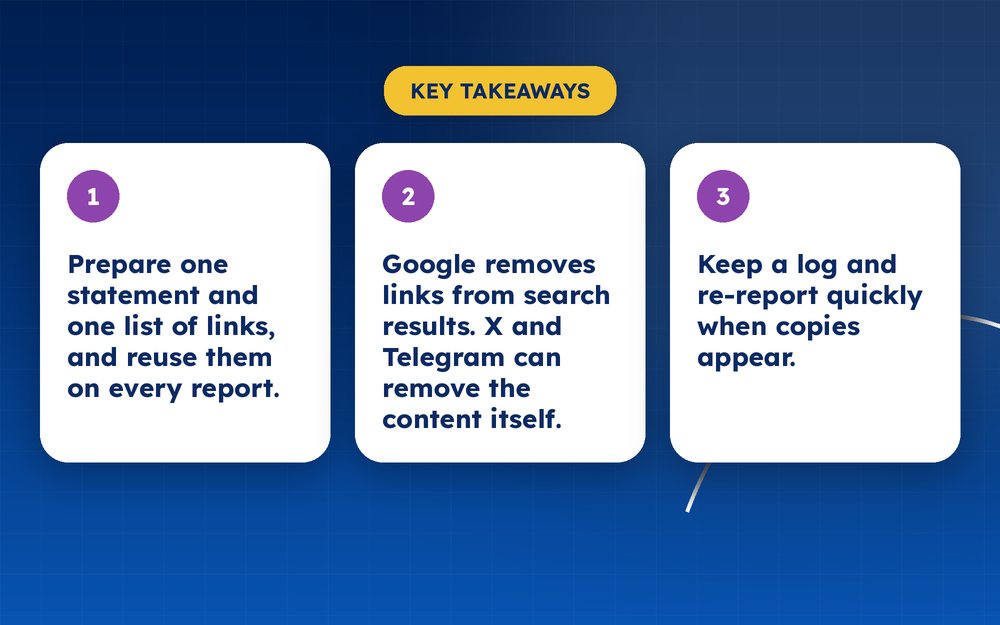
- Prepare one statement and one list of links, and reuse them on every report.
- Google removes links from search results. X and Telegram can remove the content itself.
- Keep a log and re-report quickly when copies appear.
How to report, step by step
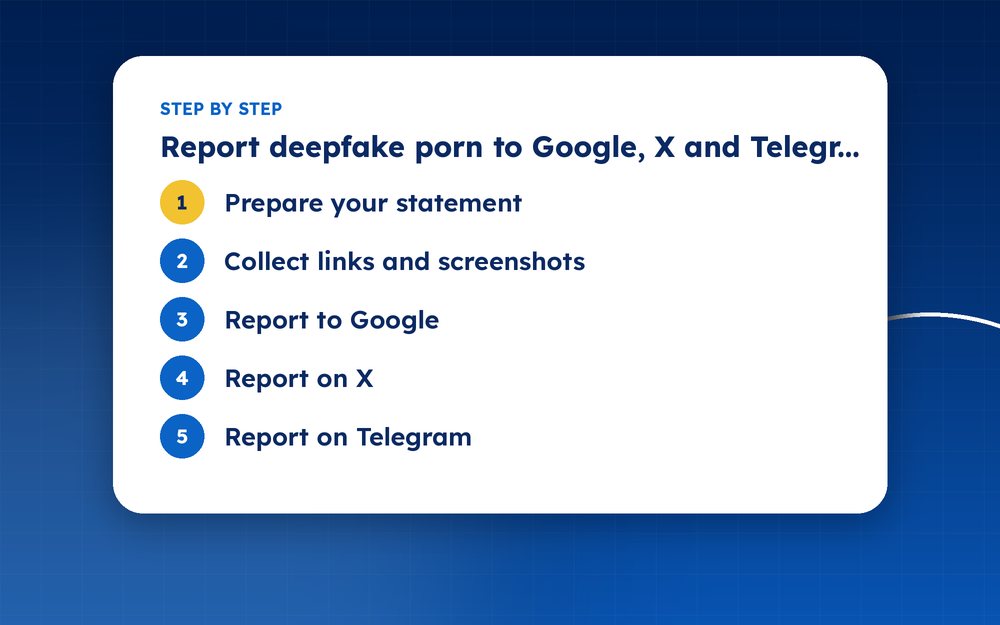
- Prepare your statementWrite two or three sentences: you are the person depicted, the content is AI-generated and falsely shows you in a sexual way, and you did not consent. Write two or three sentences: this is a fake sexual image of me, I did not consent and I ask for removal. Keep it factual.
- Collect links and screenshotsList the exact web address of every post, page and message link, with screenshots showing the date. Collect links to each post and page, with screenshots and dates. Number them in a document.
- Report to GoogleUse the form for non-consensual explicit imagery and include all links. Keep the confirmation. Use Google's process for removing non-consensual explicit imagery, including synthetic images, and submit the links. Ask for similar results to be filtered.
- Report on XUse the post report option for non-consensual intimate or synthetic media, and report the account that posted it. Use X's reporting tool for non-consensual nudity and report the post and account. Add your statement.
- Report on TelegramReport the messages, channels and groups in the app, and email the abuse contact with exact links. Use Telegram's in-app reporting and its email contact for illegal content, with message links.
- Report to other platformsSearch for further copies on forums, tube sites and image hosts and report each. Other sites and forums have their own forms. Use the same statement and links.
- Track and follow upRecord the date and reference of each report. Re-report if nothing happens, quoting your earlier request. Keep a record of each report and follow up after a few days. Repeat for reposts.
Using the right words
Reviewers handle large volumes, so a clear statement helps. Use terms like non-consensual, sexual, synthetic or AI-generated, and say that the image falsely shows you. Avoid long stories in forms, and keep detailed explanations for emails.
If a form only has category choices, pick the one closest to non-consensual intimate imagery, and use any free-text box to add the word fake.
Why three places matter
Search engines make the content findable, social platforms spread it quickly, and messaging channels host the shared copies. If you only deal with one, the others keep it alive. Reporting to all three, then following up, cuts the cycle.
Hash tools such as StopNCII.org may also help for adults, where platforms take part and where you hold the relevant image.
If you do not want to see the content
You can have someone else collect links and send you only the list. Professional services can do this routinely. You do not need to look at the content again to report it.
What a typical case looks like
A woman finds a fake explicit video of her on a social platform and in a Telegram channel. She writes a short statement, lists nine links and reports each. The social platform removes the post within a day, Telegram removes the channel in four days and Google removes the search results within a week. She keeps her list and finds a repost two weeks later, which she reports using the same statement.
Reusing the statement and list saved her energy.
Common mistakes to avoid
Do not forward the fake. Do not comment on posts. Do not report without saving evidence. Do not stop after one platform. And do not pay anyone who promises removal without explaining how.
How a specialist can help
Reporting across several platforms with exact links and follow-ups takes time. A specialist team can prepare and send reports, track replies and monitor for new copies. We cannot promise every copy will come down, but we will be honest about what is realistic. Email us in confidence.
Frequently asked questions
How do I report deepfake porn to Google?
Use Google's form for non-consensual explicit imagery, list the links and ask for similar results to be filtered.
Does X remove these images?
X prohibits non-consensual nudity and acts on reports, including for synthetic images.
What about Telegram?
Report in the app and by email with message links. Response times vary.
How fast are removals?
Often within days, though it varies by service.
Will they come back?
Possibly. Keep your list and check regularly.
Is this legal advice?
No. It is general information, and laws differ by country. For claims or court action, speak to a qualified lawyer.
Need help with this?
Every situation is different. Email us the details in confidence and we will reply with an honest assessment of what can be done.
Contact us by email Deepfake removalThis guide is general information, not legal advice. DMCA Reputation is not a law firm.
Related guides
How to Remove Images Made by a Nudify App
How to remove images made by a nudify app: how these apps work, how to report the images and the app, remove search results and protect your photos from future misuse.
Read the guide · 4 min
Are Deepfakes Illegal? Laws by Country
Are deepfakes illegal? A general overview of how different countries treat sexual and misleading deepfakes, and how the law connects to getting them removed.
Read the guide · 4 min
How to Remove Deepfakes of Yourself
How to remove deepfakes of yourself: documenting evidence, platform reports, search removal and legal options for AI-generated fake images and videos.
Read the guide · 4 min