
Deepfakes are not illegal in themselves in most places, but many uses are: sexual deepfakes, fraud, harassment and defamation. The law is changing fast, so this is a general overview.
This page is general information, not legal advice. Laws about synthetic media are being updated in many countries, and details differ by place. Use it to know what questions to ask, and speak to a lawyer for advice about your case.
A useful way to think about it: the technology is usually legal, but harmful uses may break existing laws on intimate image abuse, fraud, impersonation, harassment, privacy or defamation. Several countries have added laws specifically about sexual deepfakes.
Laws on deepfakes are changing quickly, and many countries now have specific rules for sexual images or election content. Because details change, treat this as a starting point and check current rules where you and the person responsible live.
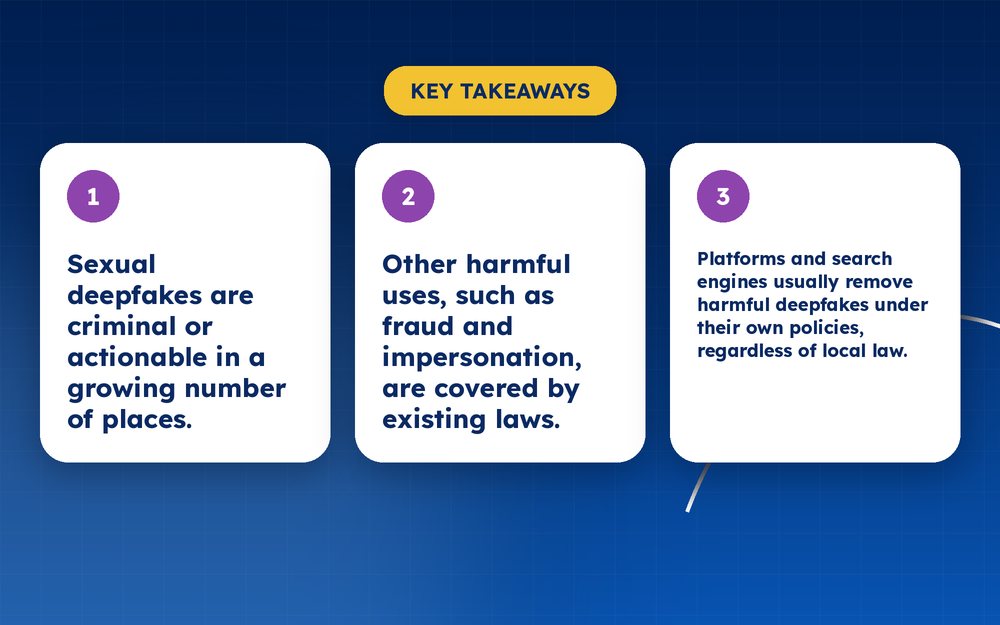
- Sexual deepfakes are criminal or actionable in a growing number of places.
- Other harmful uses, such as fraud and impersonation, are covered by existing laws.
- Platforms and search engines usually remove harmful deepfakes under their own policies, regardless of local law.
How to use this information, step by step
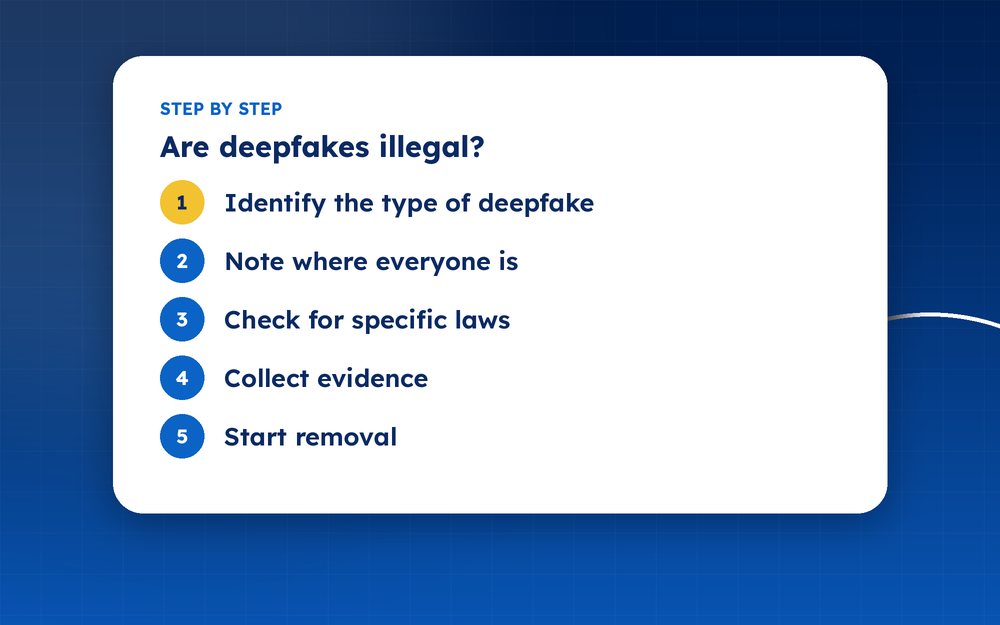
- Identify the type of deepfakeSexual, financial, political, defamatory or impersonation. The law differs by type. Is it a sexual image, a fake ad, a political video or a prank? The type often decides which laws apply.
- Note where everyone isWhere you live, where the creator is and where the content is hosted can all matter. Write down the country where you live, where the person lives and where the platform is based. Each may matter.
- Check for specific lawsSearch for deepfake or synthetic media laws in your country or state, or ask a local support service. Look for laws on non-consensual intimate images, harassment, fraud, defamation or impersonation. Some places have laws specific to deepfakes.
- Collect evidenceSave links, screenshots, dates and any messages. Evidence supports every route. Save links, screenshots and dates. Evidence supports any route.
- Start removalPlatform reports and search engine requests do not depend on a legal case. You do not need to wait for a criminal case. Platform and search engine reports can be made now.
- Speak to a lawyer for claimsA lawyer can advise on criminal reports, civil claims and cross-border issues. If you want to claim compensation or pursue the person, a lawyer in the relevant country can advise.
United States
The United States has a patchwork of state laws on sexual deepfakes and election-related deepfakes, and federal law has begun to address the issue. The TAKE IT DOWN Act requires covered platforms to remove reported non-consensual intimate images, including certain digital forgeries, within 48 hours of a valid request.
United Kingdom and Europe
The UK has criminalised sharing and, more recently, creating certain sexual deepfakes, and online safety rules put duties on platforms. EU countries apply national criminal law, and EU rules on violence against women and on digital services add standards. Details differ by country.
Australia, Canada and Asia
Australia has criminalised sharing sexually explicit deepfakes and the eSafety Commissioner can act on removal. Canada relies on its criminal offence for intimate images and other laws, and is debating further reform. Several Asian countries, including South Korea, have strong rules on sexual deepfakes. Check the current position in each place.
What a typical case looks like
Someone finds a fake explicit video of herself made by a person in another country. She saves evidence, reports to the platforms and search engines, and makes a police report where she lives. She learns that her country has a specific offence, while the other country has a more general one. A lawyer explains what is realistic across the border.
Starting with platform routes gave quick relief while the legal questions were explored.
What this means for removal
Even where the law is unclear, platforms and search engines tend to act on non-consensual sexual deepfakes. If you want to pursue a claim or a prosecution, speak to the police or a lawyer, and contact us if you would like a recommendation. We do not promote particular law firms in our guides.
How a specialist can help
Whatever the law says, removal is a practical job of finding, reporting and monitoring. A specialist team can handle that while you decide on any legal steps. We are not a law firm and cannot give legal advice. Email us in confidence.
Frequently asked questions
Are deepfakes illegal?
It depends on the content and the country. Sexual deepfakes without consent are illegal or actionable in many places, and other kinds may fall under fraud, harassment or defamation.
Do I have to wait for the law to change?
No. Platforms and search engines act on reports now.
What if the person is overseas?
Cross-border enforcement is harder. Platform routes and local police reports are still valuable.
Where can I check the law?
Official government sites and a local lawyer.
Does it matter that the image is fake?
Many laws and platform policies cover fakes as well as real images.
Is this legal advice?
No. It is general information, and laws differ by country. For claims or court action, speak to a qualified lawyer.
Need help with this?
Every situation is different. Email us the details in confidence and we will reply with an honest assessment of what can be done.
Contact us by email Deepfake removalThis guide is general information, not legal advice. DMCA Reputation is not a law firm.
Related guides
How to Tell If a Video of You Is a Deepfake
How to tell if a video of you is a deepfake: visual and audio clues, tools and checks, and how to prove it is fake when you report it. A practical guide.
Read the guide · 4 min
How to Remove a Deepfake of a CEO or Public Figure
How to remove a deepfake of a CEO or public figure: fast response plan, platform reports, search removal, legal routes and how to protect trust with customers.
Read the guide · 4 min
How to Remove Deepfakes of Yourself
How to remove deepfakes of yourself: documenting evidence, platform reports, search removal and legal options for AI-generated fake images and videos.
Read the guide · 4 min