
Piracy often begins within days of a launch, when attention is highest. A little preparation before you go live makes leaks harder, easier to trace and quicker to remove.
You cannot make a course piracy-proof. If someone can watch it, someone can record it. But you can raise the effort needed, make leaks traceable and have takedown tools ready, so a leak costs you less.
Most of this work takes a few hours before launch, and it pays off every time something goes wrong.
Prevention will never be perfect, but a few small steps before launch make leaks rarer and make responses faster when they happen. Do them now, while you have time.
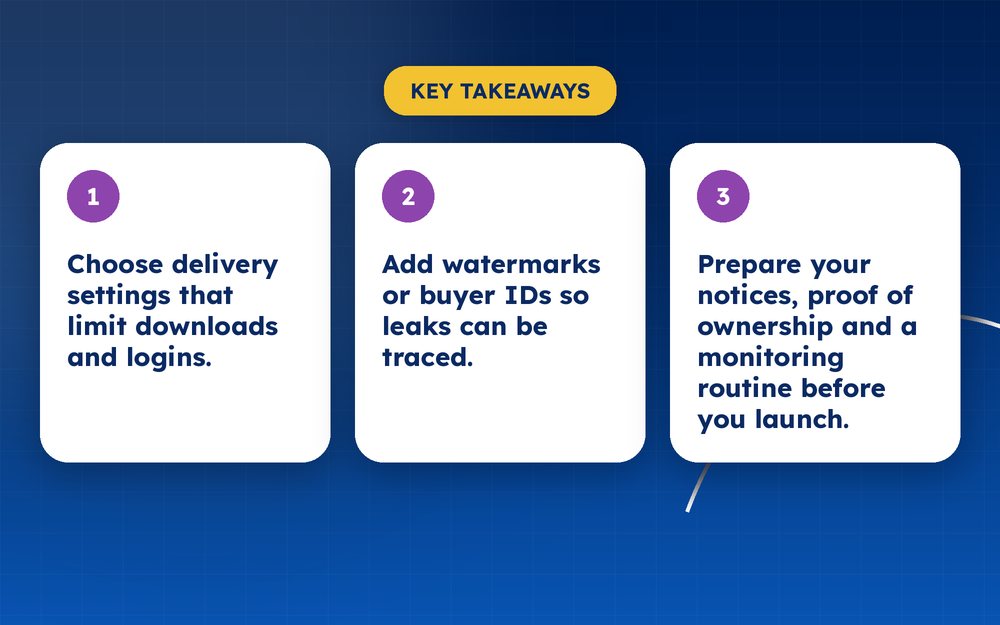
- Choose delivery settings that limit downloads and logins.
- Add watermarks or buyer IDs so leaks can be traced.
- Prepare your notices, proof of ownership and a monitoring routine before you launch.
Your pre-launch checklist, step by step
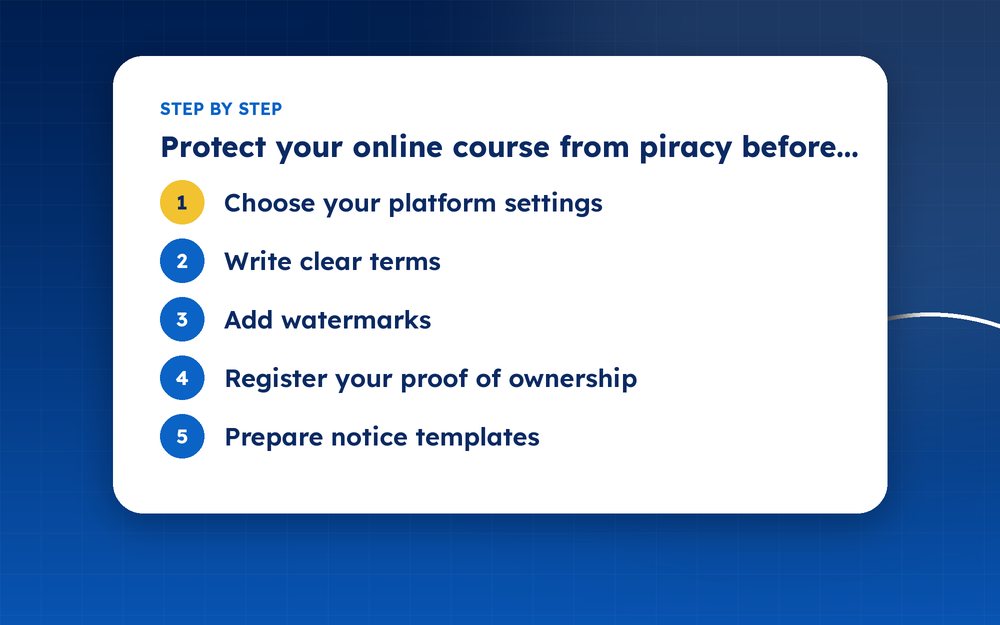
- Choose your platform settingsTurn off downloads where you can, limit simultaneous logins and use expiring links for files. Check your platform for limits on logins, downloads and sharing. Turn on what suits your students.
- Write clear termsState that content is for personal use and what happens if it is shared. Write terms that clearly forbid sharing and resale, and show them at sign-up.
- Add watermarksPlace the buyer's name or ID in a subtle, hard-to-crop position, if your platform supports it. Add a watermark with the member's email or ID to videos and files, so leaks can be traced.
- Register your proof of ownershipKeep original files, dates and sales records, and consider formal copyright registration if relevant in your country. Keep original files and dated records, and register your work where it makes sense in your country.
- Prepare notice templatesHave a standard DMCA notice ready, plus a list of platform forms. Write a notice template and list the contacts for common platforms, so you can act in minutes.
- Set up monitoringCreate search alerts and decide who checks channels and forums. Set up alerts and a weekly search for your course name, brand and lessons.
- Plan for launch weekAssign time to check for leaks daily during launch week. Launch week attracts leaks. Block out time to monitor and respond quickly.
Balancing protection and customer experience
Heavy restrictions can annoy honest customers. Think about what your audience will accept. A high-priced professional course can justify strict controls, while a low-cost course may do better with light measures and good monitoring.
Why watermarking works
Visible or hidden buyer identifiers do not stop recording, but they make leaks traceable, which deters casual sharing. Tell buyers that content is marked, so they know sharing can be traced.
Preparing your notices
Keep a document with your details, links to originals and a notice template. When a leak appears, you can send notices in minutes instead of hours. Keep a log from day one.
Creating value that piracy cannot copy
Live sessions, community access, feedback and updates are harder to pirate than recorded videos. Adding these can make legitimate purchase more attractive.
What a typical case looks like
A creator preparing a launch turns on login limits, adds watermarks and writes notice templates. On day three, a lesson appears on a forum. Because the watermark shows a member ID, she contacts the member, and the post is removed within an hour. She sends a notice for a second copy using her template.
Her preparation turned a stressful event into a short task.
Common mistakes to avoid
Do not wait until after a leak to prepare. Do not rely on a single measure. Do not forget to update terms. And do not ignore early signs of sharing.
How a specialist can help
A specialist team can set up monitoring and handle takedowns from day one of launch. We cannot promise to prevent piracy, but we will be honest about what is realistic. Email us in confidence.
Frequently asked questions
Can I fully prevent piracy?
No, but you can reduce it and respond quickly.
Do watermarks help?
They discourage sharing and help trace leaks.
Should I use strict limits?
Use limits that protect without frustrating honest students.
What should be in my notice template?
Your details, the work, space for links and the required statements.
When should I start monitoring?
Before launch, so you have a baseline.
Is this legal advice?
No. It is general information. For claims or court action, speak to a qualified lawyer.
Need help with this?
Every situation is different. Email us the details in confidence and we will reply with an honest assessment of what can be done.
Contact us by email Piracy monitoringThis guide is general information, not legal advice. DMCA Reputation is not a law firm.
Related guides
What to Do When Your Course Is Sold on Another Website
What to do when your course is sold on another website: document the sale, send notices to the site, host and payment provider, and cut off search and ad traffic.
Read the guide · 3 min
What to Do When Someone Sells Your Course by Direct Message
What to do when someone sells your course by direct message: collect evidence safely, report accounts, notify platforms and payment providers and warn your audience.
Read the guide · 3 min
How to Send a DMCA Takedown Notice (With Template)
How to send a DMCA takedown notice: what to include, who to send it to, a free template, counter-notices and common mistakes.
Read the guide · 5 min