
Weddings and events are emotional, and when something goes wrong the review can be harsh. Some reviews break Google's rules, and most can be handled with a calm, well-judged reply.
Event businesses face reviews from clients with high expectations, from guests who were not clients, and occasionally from competitors. Many reviews are honest complaints and will stay. A few break Google's policies and can be removed.
This guide helps you tell the difference, report where appropriate and respond in a way that reassures future clients.
Wedding and event reviews are emotional, and a single unhappy client can post a long review. Facts, calm replies and quick offers to resolve issues are your best tools.
- Flag reviews that are off-topic, abusive, fake or from non-customers.
- Use contracts and communications to understand the situation before replying.
- Reply calmly, and focus on future clients reading it.
How to deal with it, step by step
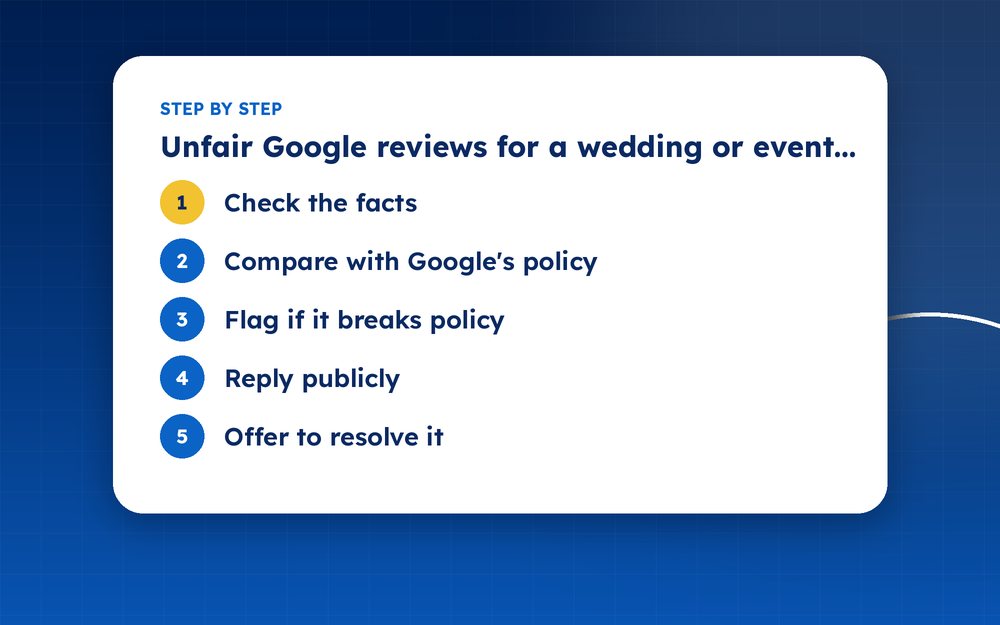
- Check the factsLook at your contract, messages and payments to understand what happened. Check the contract, messages, payments and photos to see what happened. Be honest about what you could have done better.
- Compare with Google's policyCheck whether the review is fake, abusive, off-topic or from someone who was not a client. Read Google's policy and see whether the review breaks any rule, such as fake engagement, off-topic content or harassment.
- Flag if it breaks policyUse the flag option with the closest reason. If it does, flag it and add a short, factual explanation. Keep the report separate from your reply.
- Reply publiclyThank the reviewer, address the concern briefly and offer to discuss privately. Write a calm public reply that thanks the person, states key facts briefly and invites them to talk.
- Offer to resolve itIf the complaint is fair, offer a fix. A resolved issue sometimes leads to an updated review. Contact the client privately, if appropriate, and offer to listen. Some will update the review once resolved.
- Collect genuine reviewsAsk happy clients to review after the event. Ask happy clients for reviews soon after the event, when it is fresh.
- Keep recordsSave screenshots and the dates of replies. Keep a record of reports, replies and agreements.
Reviews that may be removed
Examples include reviews from people who were not clients, reviews with abusive language, reviews by competitors and reviews that mention a different business. A bad experience, even one you disagree with, usually remains.
Writing a reply for future clients
Future clients read replies to judge how you handle problems. A calm, specific and respectful reply is more persuasive than a defensive one. Avoid arguing, and avoid sharing private details.
Using contracts well
Clear contracts with expectations, timelines and cancellation terms reduce disputes. If a dispute leads to a review, a reply that points to what was agreed, politely, can help readers understand.
Timing review requests
Ask for reviews soon after a successful event, while memories are fresh. Make it easy with a direct link, and follow Google's rules on incentives.
What a typical case looks like
A florist receives a one-star review blaming her for a late delivery at a wedding. She checks the contract and messages and finds the venue had changed the time. She replies politely with the facts and invites the client to call. The client apologises and updates the review to four stars. She also asks recent clients for reviews.
A calm reply and a private conversation did more than a report could.
Common mistakes to avoid
Do not argue in public. Do not offer rewards for positive reviews. Do not ignore reviews. And do not post fake reviews yourself.
How a specialist can help
If a review campaign or a policy-breaking review needs more than a flag, a specialist team can gather evidence and follow up with Google. We cannot promise removal, but we will be honest about what is realistic. Email us in confidence.
Frequently asked questions
Can I remove an unfair review of my event business?
If it breaks Google's policy, yes. If it is a genuine complaint, a reply is usually better.
Should I reply publicly?
Yes, briefly and politely.
Should I contact the client?
If appropriate, yes. A private conversation can resolve things.
What if the review is false?
Flag it with evidence and keep your reply factual.
When should I ask for reviews?
Soon after the event, while memories are fresh.
Is this legal advice?
No. It is general information, and laws differ by place. For claims or court action, speak to a qualified lawyer.
Need help with this?
Every situation is different. Email us the details in confidence and we will reply with an honest assessment of what can be done.
Contact us by email Google review removalThis guide is general information, not legal advice. DMCA Reputation is not a law firm.
Related guides
How to Handle Unfair Reviews for a Golf or Country Club
How to handle unfair reviews for a golf or country club: member disputes, policy-breaking reviews, how to reply and how to protect member privacy. General information.
Read the guide · 3 min
Can You Sue Over a Fake Google Review in the UK or Ireland?
Can you sue over a fake Google review in the UK or Ireland? A general explanation of defamation routes, evidence, anonymity and when removal is simpler. Not legal advice.
Read the guide · 4 min
How to Remove a Google Review: A Complete Guide for Business Owners
How to remove a Google review: what Google will remove, how to report it, how to appeal and what to do if it stays. A guide for business owners.
Read the guide · 6 min