
The EU Digital Services Act requires online platforms to offer notice-and-action tools for illegal content. A well-prepared notice can speed up removal of content that is illegal in the EU.
This page is general information, not legal advice. The Act requires hosting services to provide easy mechanisms to report content the reporter believes is illegal. A notice should explain why, give the exact location, and include the reporter's details and a statement of good faith.
Platforms must then process notices, inform the reporter of their decision and, in many cases, tell the affected user and offer an appeal route.
The notice tools required under the Act are meant to be easy to find and use. A precise notice that explains why something is illegal under law gives the platform a reason to act, and you a right to a reasoned reply.
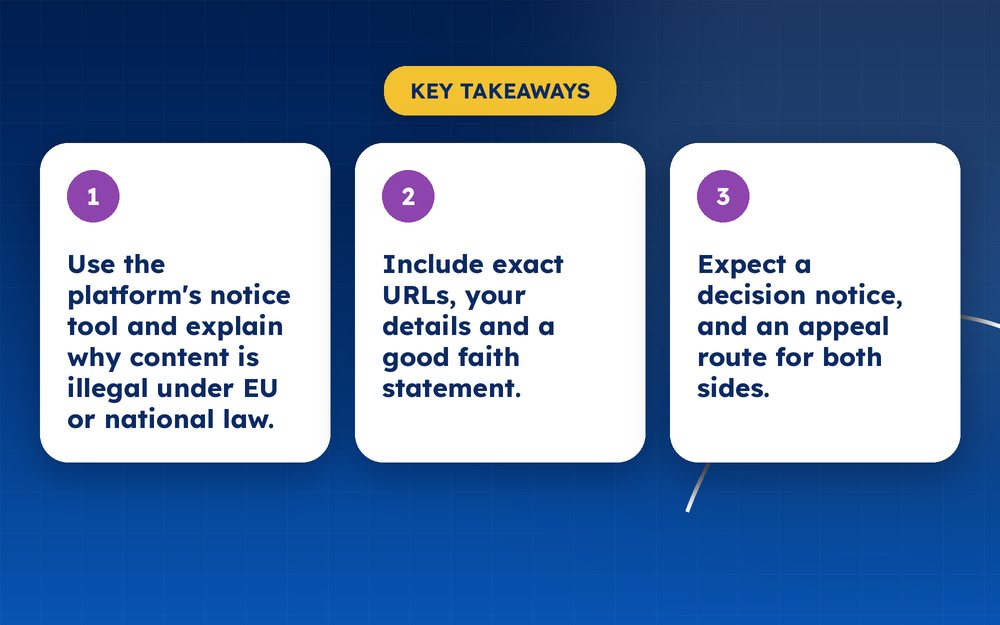
- Use the platform's notice tool and explain why content is illegal under EU or national law.
- Include exact URLs, your details and a good faith statement.
- Expect a decision notice, and an appeal route for both sides.
How to use it, step by step
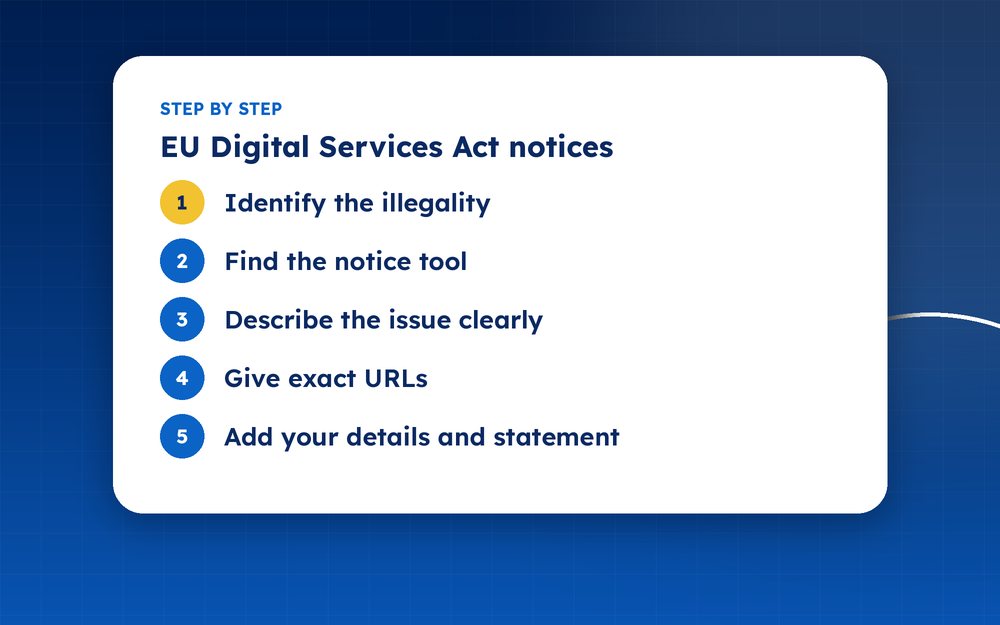
- Identify the illegalityDecide which law the content breaks, such as copyright, intimate image abuse, threats or defamation under national law. Work out which law the content breaks, such as defamation, privacy, hate speech or copyright, in the relevant country.
- Find the notice toolLook for a report illegal content option. Look for the notice and action mechanism on the platform, often a report option labelled for illegal content.
- Describe the issue clearlyExplain why the content is illegal. Explain clearly why the content is illegal, with a short reference to the law if you know it.
- Give exact URLsProvide precise locations. Give the exact link or location of the content, not just the account name.
- Add your details and statementInclude contact details and a statement of good faith, unless the type of notice allows otherwise. Provide your name and email, unless the content is of a kind where anonymity is allowed, and a statement that the notice is accurate.
- Keep the confirmationSave the acknowledgement. Keep the confirmation. The platform should acknowledge your notice.
- Use appeals and out-of-court bodiesIf the decision is unsatisfactory, use the platform's complaint system and certified dispute bodies. If rejected, you may be able to appeal inside the platform, use an out-of-court dispute body or take other action.
What counts as illegal content
The Act refers to content that is illegal under EU or member state law. This can include copyright infringement, certain hate speech, intimate image abuse and others, depending on the country. Local law matters.
Trusted flaggers
Some organisations are designated as trusted flaggers, and platforms must prioritise their notices. Individuals use the standard route.
Decisions and appeals
Platforms must give reasons for decisions in many cases and offer internal complaint handling. Out-of-court dispute settlement bodies may also be available.
Limits
The Act does not require removal of content that is simply unpleasant or legal. It also applies to services offered in the EU, and its enforcement is handled by authorities.
What a typical case looks like
A person in an EU country finds a post that falsely accuses her of a crime. She submits a notice through the platform tool, citing the law on defamation, with the exact link and her details. The platform acknowledges it and, after review, removes the post and tells her the reason. If it had refused, she could have appealed or used an out-of-court body.
A precise notice made the decision easier for the platform to reach.
Common mistakes to avoid
Do not send vague notices. Do not forget URLs. Do not claim illegality without a basis. And do not ignore appeal options.
How a specialist can help
A specialist team can prepare notices and follow up with platforms. We are not a law firm and cannot give legal advice. Email us in confidence.
Frequently asked questions
What is a DSA notice?
It is a report that content is illegal, submitted through a mechanism that large and other online platforms must provide in the EU.
Does the platform have to remove it?
Not automatically, but it must handle notices diligently and give reasons for its decision.
Can I appeal a refusal?
Often yes, through internal appeals and sometimes out-of-court bodies.
Do I need to cite a law?
It helps to explain why the content is illegal, but you do not have to be a lawyer.
Does it apply outside the EU?
The Act covers services offered in the EU. Other regions have different rules.
Is this legal advice?
No. It is general information, and laws differ by country. For advice on your situation, speak to a qualified lawyer.
Need help with this?
Every situation is different. Email us the details in confidence and we will reply with an honest assessment of what can be done.
Contact us by email DMCA takedown serviceThis guide is general information, not legal advice. DMCA Reputation is not a law firm.
Related guides
Singapore Harassment and Online Safety Laws: What Victims Can Use
Singapore harassment and online safety laws: what victims can use, protection orders, platform reporting and recent online safety developments. General information.
Read the guide · 3 min
How to Use Australia's eSafety Commissioner for Removal
How to use Australia's eSafety Commissioner for removal: which harms it covers, how to report, what to report to the platform first and what to expect. General information.
Read the guide · 3 min
How to Send a DMCA Takedown Notice (With Template)
How to send a DMCA takedown notice: what to include, who to send it to, a free template, counter-notices and common mistakes.
Read the guide · 5 min