
When someone sells your content for profit, they are taking money you earned. Because it is commercial piracy, platforms and payment providers often act faster than on free leaks.
Sellers may operate on marketplaces, social media, chat apps or their own sites. They may sell bundles of creators' content, or sell access to private groups. Sales leave traces such as payment links and advertisements, which help you report them.
Evidence of sales strengthens your case: it shows commercial use and can lead to action against the seller's accounts and payment methods.
Selling stolen content depends on payments and visibility, so the most effective pressure is on those two things. Evidence of sales gives you a stronger case.
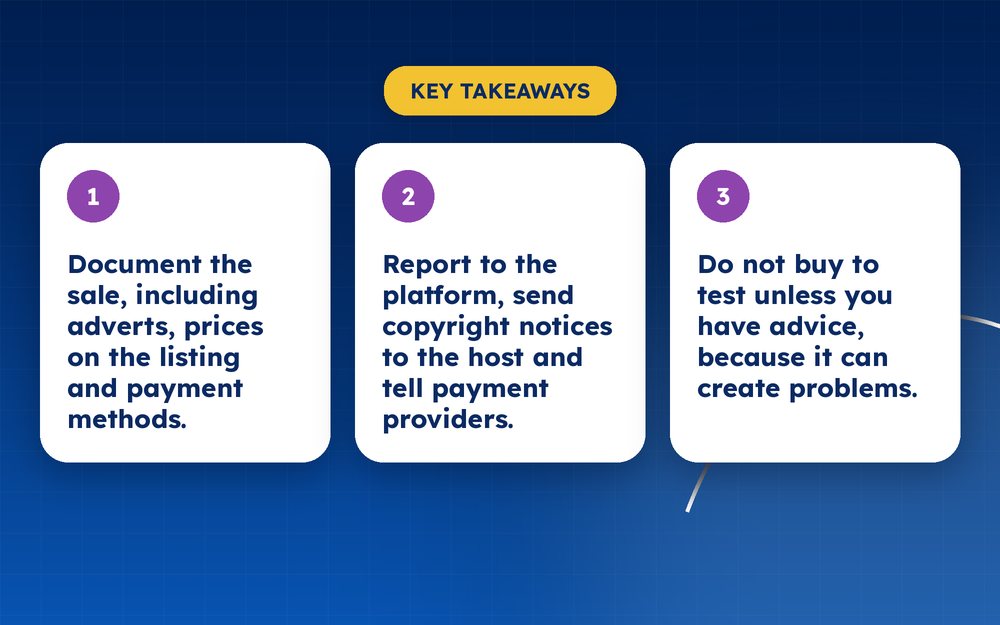
- Document the sale, including adverts, prices on the listing and payment methods.
- Report to the platform, send copyright notices to the host and tell payment providers.
- Do not buy to test unless you have advice, because it can create problems.
How to report, step by step
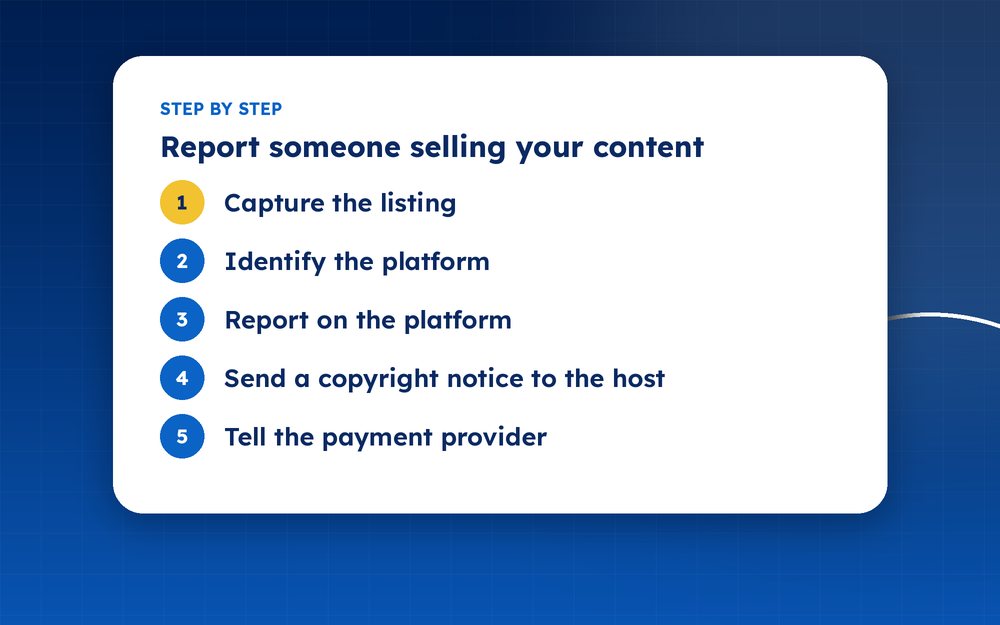
- Capture the listingScreenshot adverts, profile pages, payment links and any description of what is sold. Save the listing, prices, seller name and any proof of sales. Record the date and screenshots.
- Identify the platformWork out whether the sale is on a marketplace, a social platform, a chat app or a website. Note whether the seller uses a marketplace, a social platform or a private website. This decides your route.
- Report on the platformUse copyright and scam or counterfeit routes, quoting the listing. Report the listing on the platform as infringement and selling stolen content, with proof of ownership.
- Send a copyright notice to the hostIf the seller runs a site, send a notice to the host with the links. If the seller uses a website, send notices to its host and delivery network.
- Tell the payment providerReport the seller to the payment service shown on the listing. Many have rules against selling infringing content. Tell the payment providers that the seller is selling infringing content. They often have strict rules.
- Ask search engines to remove linksSubmit copyright removal requests for the sales pages. Submit the listing pages to search engines, to cut visibility.
- Keep a record and monitorSellers return under new names. Keep notes on usernames and domains. Keep a log of reports and responses, and search for new accounts.
Why payment routes help
Sellers depend on payment services, and these companies can close accounts that break their rules. A short report with evidence that the listing sells infringing content can lead to account limits, which stops the sale in practice, even if the content remains elsewhere.
Avoiding trouble
Do not buy the content yourself to gather evidence without advice. It may create legal or safety problems. Use screenshots and the seller's own descriptions as evidence instead.
If the seller is someone you know
If you know who is selling it, such as a former contact or partner, consider whether to involve the police, and speak to a lawyer about a claim. We are not a law firm and cannot advise on that, but removal can proceed alongside it.
What good evidence looks like
The best evidence shows the sale clearly: the advert, the price or offer, the payment method and the seller's account details, all with dates. Screenshots that include the web address help. If the seller's listing names you or your handle, capture that too.
Keep evidence in a folder that only you can reach, and do not edit screenshots. If you later decide to involve the police or a lawyer, tidy, dated evidence saves time and makes your case more credible.
Also note any messages from people who bought the content, since they can show the scale of the sales and help payment providers and platforms see the pattern.
What a typical case looks like
A creator finds an account selling her content in a private channel with a payment link. She saves screenshots and reports the account and the channel. She reports the payment provider, which closes the account. The platform bans the seller within three days. A new account appears the next week, and she reports it using the earlier evidence.
Cutting off payments mattered as much as removing the listings.
Common mistakes to avoid
Do not engage with the seller. Do not pay them to remove content. Do not skip the payment provider. And do not stop after one takedown, since sellers often move accounts.
How a specialist can help
Specialists can document listings, send notices to platforms, hosts and payment providers, and monitor for new sellers. We cannot promise every seller will be stopped, but we will be honest about what is realistic. Email us in confidence.
Frequently asked questions
Can I stop someone selling my content?
You can report the seller, the host and the payment provider, which often limits sales.
What evidence do I need?
Screenshots of the listing, the seller, payment details and proof you own the content.
Should I buy to prove it?
It can create risks. Consider advice first.
Will the seller come back?
Often under new names. Monitor.
Can I seek compensation?
That is a legal question. Speak to a lawyer.
Is this legal advice?
No. It is general information. For claims or court action, speak to a qualified lawyer.
Need help with this?
Every situation is different. Email us the details in confidence and we will reply with an honest assessment of what can be done.
Contact us by email OnlyFans leak removalThis guide is general information, not legal advice. DMCA Reputation is not a law firm.
Related guides
How to Trace Who Leaked Your Content Using Watermarks
How to trace who leaked your content using watermarks: visible and invisible marks, per-subscriber tracking, limits, and what to do with the evidence you find.
Read the guide · 4 min
Can You Sue a Subscriber Who Leaked Your Content?
Can you sue a subscriber who leaked your content? A plain overview of terms of service, copyright claims, identifying leakers and how removal works without court.
Read the guide · 4 min
How to Remove OnlyFans Leaks From Google and Websites
How to remove OnlyFans leaks from Google and websites: DMCA notices, search removal, platform reports and monitoring for creators.
Read the guide · 4 min