
If you know who leaked your content, you can act against them directly. Watermarks can help you trace a leak back to a source, though they are not a guaranteed fix.
Watermarks mark content so that you can see where it came from. Visible marks, such as your handle, deter casual sharing. Invisible or per-recipient marks can identify the specific account that received the file.
Tracing is only part of the picture. Even if you identify a source, you will still need to remove copies and decide what to do about the person. This guide covers the options in general terms.
Watermarks do not stop a leak. They help you find out who it came from, which can change how you respond. They work best when they are planned before you share content.
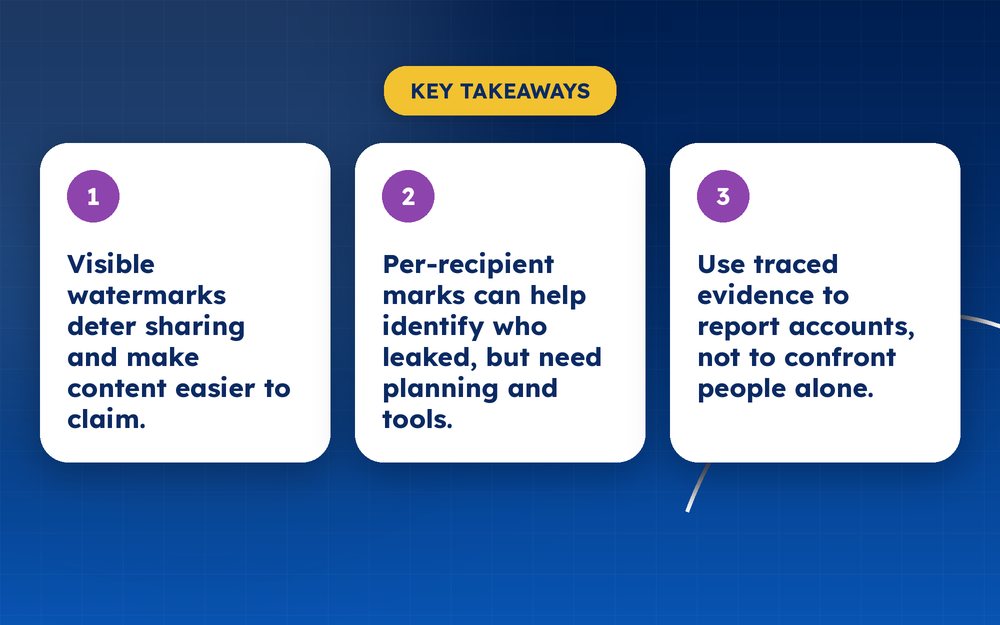
- Visible watermarks deter sharing and make content easier to claim.
- Per-recipient marks can help identify who leaked, but need planning and tools.
- Use traced evidence to report accounts, not to confront people alone.
How to use watermarks, step by step
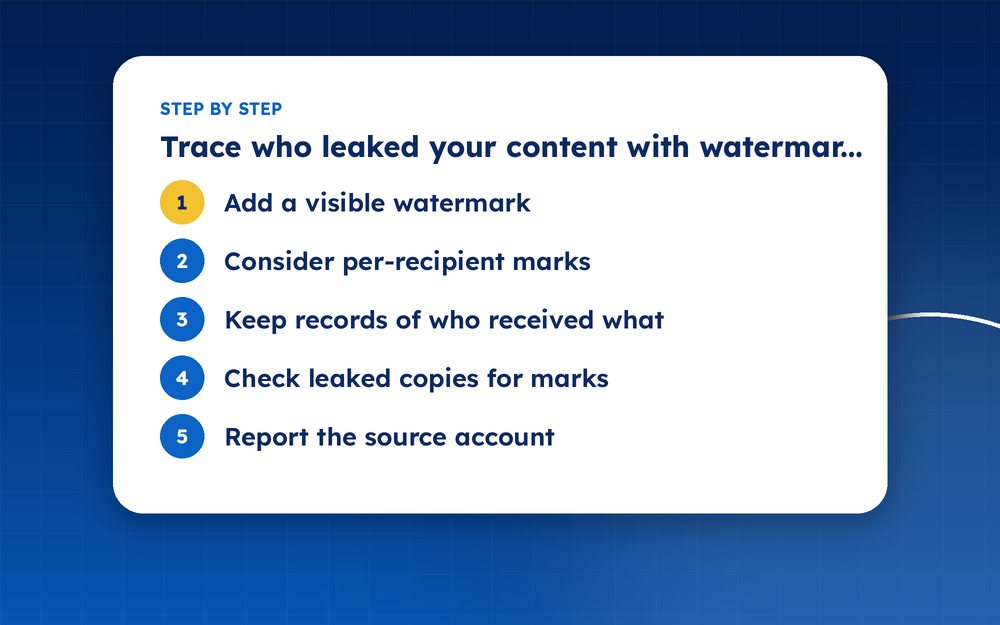
- Add a visible watermarkPlace your handle or logo where it is hard to crop, not just in a corner. A visible mark with your handle discourages copying and helps people find you. Place it where it is hard to crop.
- Consider per-recipient marksFor high-value content, use tools or services that embed unique identifiers for each recipient. For direct sales or private sets, a different mark for each recipient, such as a code in a corner, lets you trace a leak.
- Keep records of who received whatRecord which account received which file and when. Keep a simple record of which recipient received which version and when. Without it, marks are not useful.
- Check leaked copies for marksWhen a leak appears, look for the visible or hidden mark and match it to your records. When you find a leaked copy, look for the mark and match it to your records.
- Report the source accountUse the platform's report route with your evidence, so the account can be actioned. Report the account that received the content to the platform, with your evidence.
- Remove the copiesSend takedown notices and search removal requests as usual. Send notices to remove the copies, as you would for any leak.
- Decide on further actionConsider the police or a lawyer if you want to pursue the person. Decide whether to cut off the recipient, warn them or take legal advice. Keep evidence safe.
Limits of watermarks
Visible marks can be cropped or blurred, and invisible marks can be damaged by editing or recording the screen. Marking also takes effort and can reduce how polished content looks. Use it where it makes sense, and do not rely on it alone.
Respecting privacy and platform rules
If you track recipients, follow the platform's rules and privacy laws, and avoid collecting more data than you need. Be careful about publicly naming a suspected leaker, which can create legal risk and safety issues.
What to do when you identify a source
Report the account to the platform and, if appropriate, to the police. Speak to a lawyer if you want to claim compensation. Do not confront the person alone, and keep your evidence safe.
A practical approach for small creators
If per-recipient marking is out of reach, a simple approach is to place a small, unique visible mark in a hard-to-crop area of premium content, and to vary it between batches. If a leak appears, the variant tells you which batch it came from, narrowing the pool of recipients.
Pair this with a clear record of what you sent and when, and with strong account security so that leaks do not come from your own side. Even without perfect tracing, narrowing the source helps you decide whether to ban accounts, change how you distribute content or involve the police.
What a typical case looks like
A creator adds a small unique code to each custom video. A leaked video appears on a forum, and the code matches a recipient from three weeks earlier. She reports the account to the platform, which suspends it, and sends notices to the forum. She also changes how she delivers custom work.
The code turned an unknown leak into a specific account.
Common mistakes to avoid
Do not accuse someone without evidence. Do not ignore removal while chasing the source. Do not rely on visible marks only. And do not share your matching data publicly.
How a specialist can help
Watermark tracing and removal work best together. A specialist team can handle the removal and monitoring while you manage tracing and any next steps. We cannot promise every leak can be traced, but we will be honest about what is realistic. Email us in confidence.
Frequently asked questions
Do watermarks stop leaks?
No, but they discourage copying and help trace the source.
Can watermarks be removed?
Some can, so use more than one method.
Is it fair to trace a subscriber?
It is your content, and you can set terms. Be careful and fair before acting.
What if the mark is cropped?
Per-recipient marks in less obvious places help.
What should I do once I identify someone?
Report the account, remove copies and consider advice.
Is this legal advice?
No. It is general information. For claims or court action, speak to a qualified lawyer.
Need help with this?
Every situation is different. Email us the details in confidence and we will reply with an honest assessment of what can be done.
Contact us by email OnlyFans leak removalThis guide is general information, not legal advice. DMCA Reputation is not a law firm.
Related guides
Can You Sue a Subscriber Who Leaked Your Content?
Can you sue a subscriber who leaked your content? A plain overview of terms of service, copyright claims, identifying leakers and how removal works without court.
Read the guide · 4 min
How to Remove Fake OnlyFans and Fansly Accounts Using Your Photos
How to remove fake OnlyFans and Fansly accounts using your photos: report impersonation, send copyright notices, warn your audience and monitor for repeat accounts.
Read the guide · 3 min
How to Remove OnlyFans Leaks From Google and Websites
How to remove OnlyFans leaks from Google and websites: DMCA notices, search removal, platform reports and monitoring for creators.
Read the guide · 4 min