
A leaked video spreads differently from a photo: it gets copied to many sites, re-encoded and re-titled. Removal works best as a campaign with a clear order, not a single report.
Whether a video was shared by an ex, taken from a device or stolen from an account, the removal process is the same. You need a list of every copy, the right route for each site, and a way to keep checking for new uploads.
Most reputable sites remove content reported as non-consensual. Others require escalation to hosts, payment partners or search engines. This guide shows the order that tends to work.
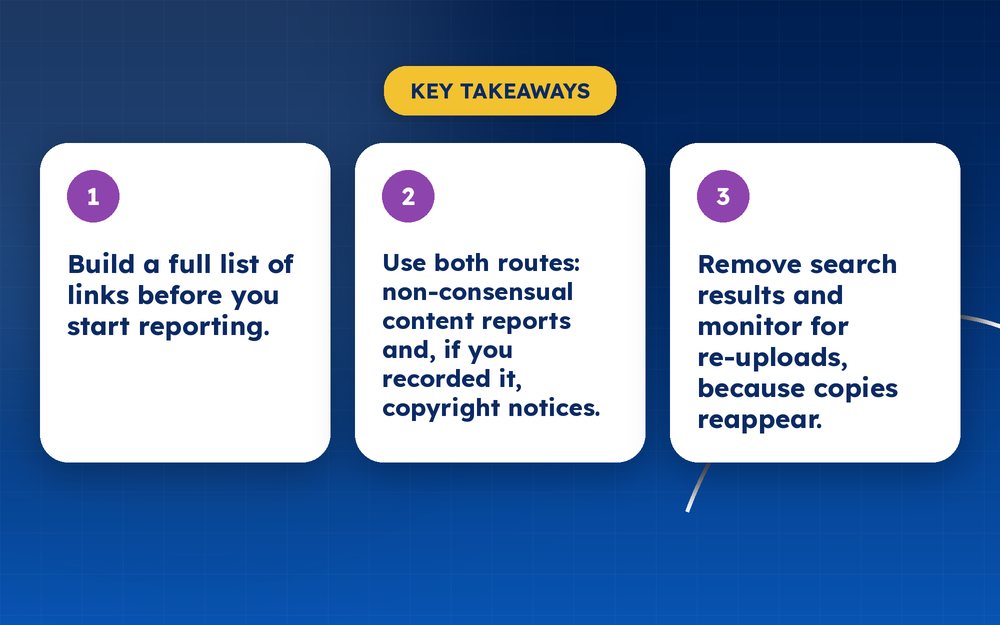
- Build a full list of links before you start reporting.
- Use both routes: non-consensual content reports and, if you recorded it, copyright notices.
- Remove search results and monitor for re-uploads, because copies reappear.
How to remove it, step by step
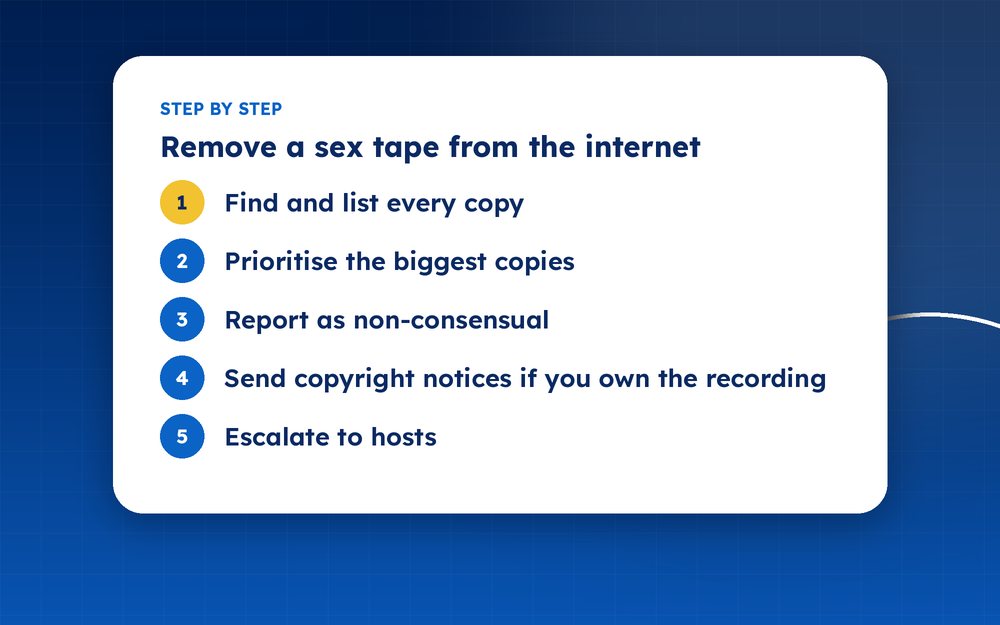
- Find and list every copySearch your name, titles used on the video and the sites where it was first shared. Save each link and a screenshot, ideally with a helper doing the searching. Search for the video by title, your name and thumbnails, and record each link. Ask someone to help.
- Prioritise the biggest copiesStart with sites with the most traffic, since those feed search results and other sites. Copies on large sites often get the most views. Deal with those first to cut visibility.
- Report as non-consensualUse each site's content removal or trust and safety form. State that you are the person shown and did not agree to publication. Report each copy as non-consensual content, saying you did not consent to distribution.
- Send copyright notices if you own the recordingIf you filmed it, a takedown notice to the site and its host can be a fast second route. If you own the recording, send copyright notices too, as they are processed formally.
- Escalate to hostsIf a site ignores you, identify the host and write to its abuse contact with your evidence. If the site ignores you, write to its host and any delivery network.
- Ask search engines to remove linksSubmit requests to Google and Bing for each link, so the video becomes harder to find. Ask Google and Bing to remove links to the pages.
- Use hash matching where it appliesIf you are an adult, StopNCII.org can help block matching uploads on participating platforms. If you are an adult, StopNCII.org can help block matching content on participating platforms.
- Monitor and repeatCheck regularly or use alerts. Report new copies quickly and mention earlier requests. Search regularly for a few months, and report new copies quickly.
Why videos reappear
Videos are often scraped and mirrored by automated sites that copy popular content. Each mirror may have its own host and its own rules. Removing the source does not remove the mirrors, which is why the list of links and the monitoring step matter.
Re-uploads also change titles and file names, which can defeat simple searches. Searching by descriptive text and by your name catches many of these.
Choosing between the non-consent and copyright routes
Non-consent reports apply whoever recorded the video. Copyright applies only if you own it, usually because you recorded it yourself. Using both can help, because some hosts respond faster to copyright notices, while some sites respond faster to non-consent reports.
Keep notices accurate. A false copyright claim can cause problems, so use that route only where it truly applies.
Cleaning up search results
Even after a video is down, search results can keep a snippet or thumbnail for a while. Ask search engines to remove the link and, where possible, to refresh the cached page. You can also build positive results over time so searches for your name show more than the leak.
What a typical case looks like
A man learns that a private video has been uploaded to several tube sites. He makes a list of 14 copies and prioritises the five with the most views. He reports each as non-consensual, and sends copyright notices for the ones he recorded. Within a week, most are gone, and the host removes a stubborn site after a second notice. He sets up a hash case and monthly searches.
Starting with the most viewed copies reduced the harm quickly.
Common mistakes to avoid
Do not pay anyone who guarantees removal without explaining how. Do not comment on the video pages. Do not download copies to keep, which creates more risk. And do not assume one successful removal means the job is done.
How a specialist can help
Tracking and reporting dozens of copies is a large job, and doing it yourself means seeing the video repeatedly. A specialist team can search, send the right notices and monitor for re-uploads. We cannot promise every copy will go, but we will be honest about what is realistic. Email us in confidence.
Frequently asked questions
Can a leaked video be fully removed?
A large share can often be removed, especially from major sites and search results, but no honest provider can promise every copy.
Do I need to prove who I am?
Some forms ask for identification. Ask how it will be used and send only what is needed.
What if the site is in another country?
You can still contact the host and search engines. Response times vary.
How long does removal take?
From days to weeks per site, depending on the response. Large cases can take longer.
Should I tell the police?
Many people do. It is your choice, and a report can support later action.
Can I stop it being uploaded again?
Hash tools and monitoring reduce re-uploads, but cannot guarantee they will not occur.
Need help with this?
Every situation is different. Email us the details in confidence and we will reply with an honest assessment of what can be done.
Contact us by email NCII removalThis guide is general information, not legal advice. DMCA Reputation is not a law firm.
Related guides
How to Use the 48-Hour Takedown Rule: Request Template and Steps
How to use the 48-hour takedown rule for intimate images: who it covers, what a valid request includes, a simple request template and what to do if a platform does not act.
Read the guide · 5 min
Intimate Image Abuse Laws by Country: US, UK, EU, Canada, Australia and Singapore
An overview of intimate image abuse laws in the US, UK, EU, Canada, Australia and Singapore, and how they affect getting content removed. General information only.
Read the guide · 4 min
How to Remove Non-Consensual Intimate Images (NCII), Step by Step
How to remove non-consensual intimate images (NCII): reporting, StopNCII.org, Google removal, legal options and support. A step-by-step guide.
Read the guide · 4 min