
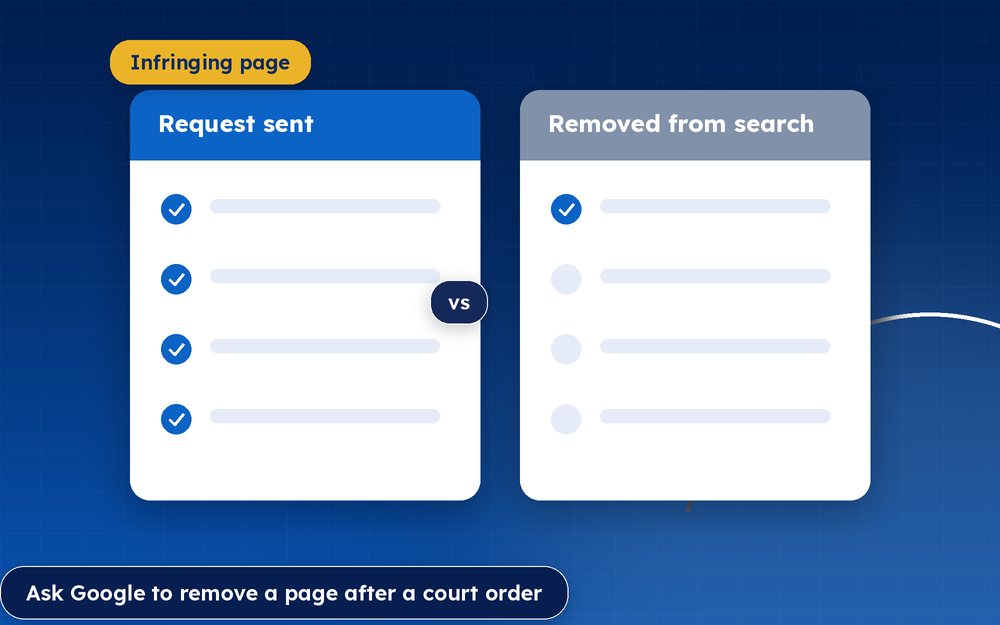
If a court has ordered content removed or declared it unlawful, you can submit that order to Google through its legal removal process. Here is how it generally works.
This page is general information, not legal advice. Google has a legal removal request process where you can submit a court order or other legal basis for removing a search result. The form asks for details about the order, the court and the URLs.
Google reviews each request and may act where it considers the order valid and applicable. Requirements differ by country, so ask your lawyer about the right documentation.
A court order gives your request more weight, but the order must be specific. Google looks at what the court actually decided, so the wording of the order and the list of links matter.
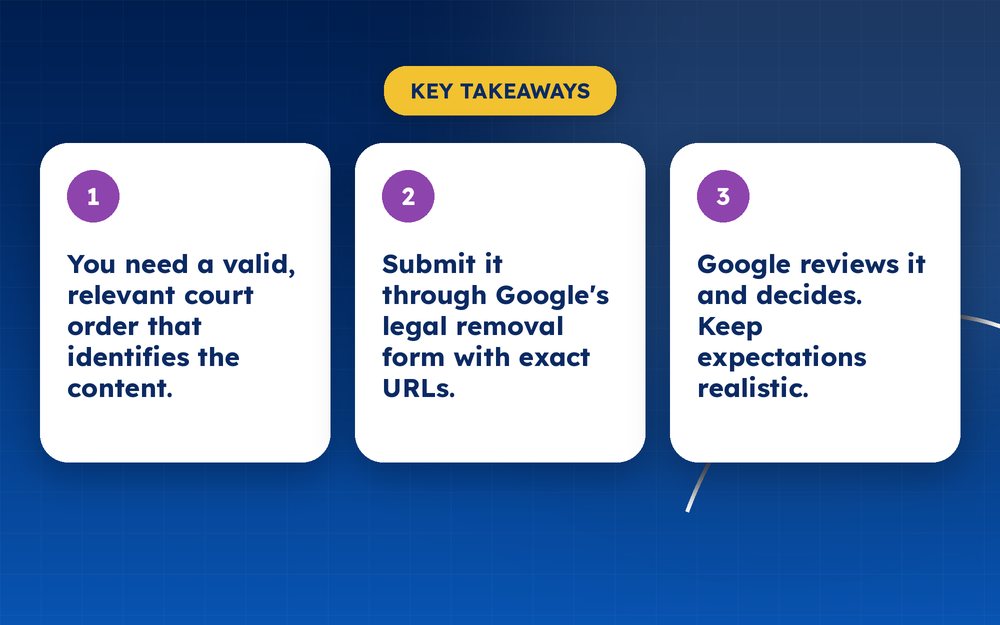
- You need a valid, relevant court order that identifies the content.
- Submit it through Google's legal removal form with exact URLs.
- Google reviews it and decides. Keep expectations realistic.
How to submit, step by step
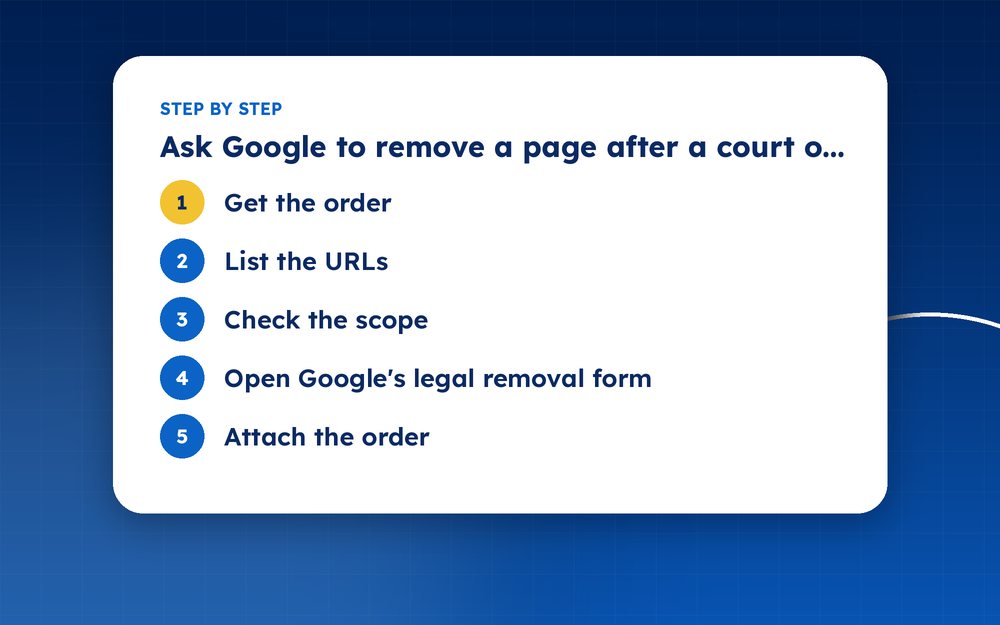
- Get the orderObtain a copy of the court order that covers the content. Obtain a copy of the signed order, ideally certified, from the court or your lawyer. Check that it is complete and dated.
- List the URLsRecord the exact addresses to be removed. List each web address the order covers, exactly as they appear. Add any that appear later only if the order allows.
- Check the scopeEnsure the order covers the content and the search results. Check that the order identifies the content or the links, and that it relates to search results or the content itself.
- Open Google's legal removal formFind the right form on Google's legal help pages. Open the form for legal removal requests and choose the option that fits your order. Fill in each section carefully.
- Attach the orderProvide the documents and explain how they apply. Upload the order and, if needed, a short cover note explaining what you ask. Avoid argument.
- Submit and keep proofSave confirmation and dates. Keep the confirmation and the dates of your submission.
- Follow upCheck results and respond to any requests for more information. If there is no response, follow up politely using the reference you were given.
What counts as a valid basis
A court order that finds content defamatory, unlawful or infringing, or that orders its removal, is the usual basis. Google may also look at local law. A lawyer can advise on whether your order is suitable.
Why the site also matters
Search removal does not delete the page. You should also send the order to the site owner and host, which can lead to the content itself being removed.
Geographical scope
Removal may apply only in certain countries, depending on the order and Google's decision. Ask your lawyer about scope and expectations.
Preparing documents carefully
Provide clear, complete copies with the court's name, case number and date. Missing details can delay review.
What a typical case looks like
A person wins a court order finding that a post about her was defamatory. Her lawyer sends her a certified copy, and she lists the five web addresses named in the order. She submits the form with the order and a one-paragraph note. Google removes the results within two weeks. A copy of the post later appears on another address, and she needs a further order or request to deal with it.
Because the order named specific links, her request was straightforward.
Common mistakes to avoid
Do not submit vague orders. Do not forget the exact URLs. Do not rely only on search removal. And do not expect instant results.
How a specialist can help
A specialist team can prepare submissions, track outcomes and send orders to sites and hosts. We are not a law firm and cannot give legal advice. Email us in confidence.
Frequently asked questions
Will Google remove a page automatically after a court order?
Not automatically. You must submit the order through the proper process, and it is reviewed.
What if the order does not list the links?
Ask your lawyer whether it can be clarified, since specific links make requests easier.
Does a court order remove the page from the web?
No. It affects search results or the content depending on the wording. The site must comply separately.
How long does it take?
Often a few weeks, though it varies.
Can I use foreign court orders?
They may be considered, but acceptance depends on the order and local rules. Ask a lawyer.
Is this legal advice?
No. It is general information. For privacy rights or claims, speak to a qualified lawyer.
Need help with this?
Every situation is different. Email us the details in confidence and we will reply with an honest assessment of what can be done.
Contact us by email Google search result removalThis guide is general information, not legal advice. DMCA Reputation is not a law firm.
Related guides
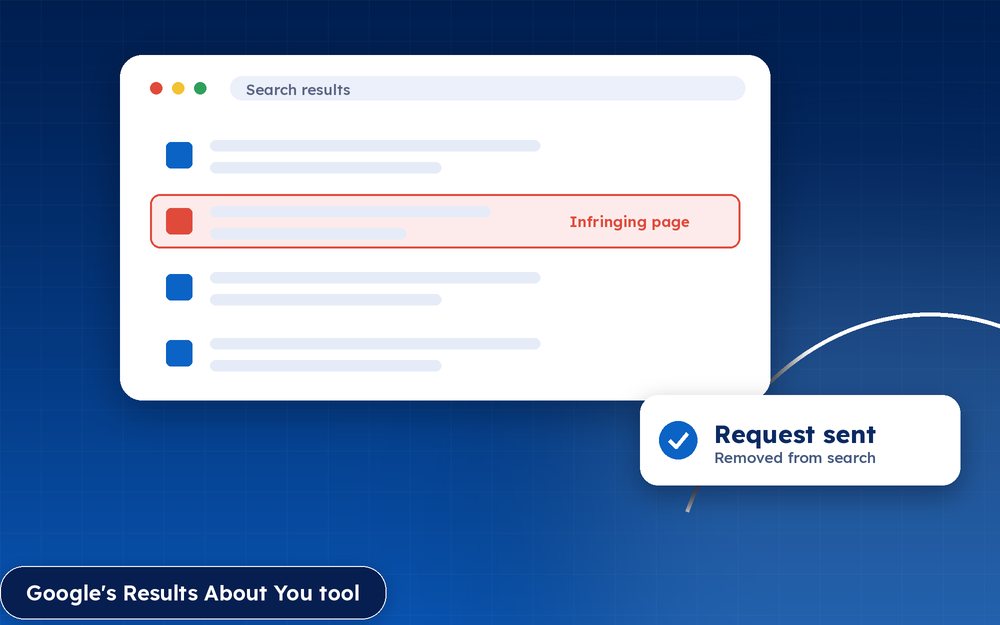
How to Use Google's Results About You Tool
How to use Google's Results About You tool: what it covers, how to set up monitoring, how to request removal of personal contact details and what it cannot do.
Read the guide · 4 min
How to Remove Your Phone Number or Address From Google
How to remove your phone number or address from Google: request removal, opt out of people-search sites, contact site owners and prevent it from reappearing.
Read the guide · 3 min
How to Refresh Outdated Content in Google Search
How to use Google's Refresh Outdated Content tool when a page or image no longer exists, or when important information has been removed from a page that stays online.
Read the guide · 4 min