
Australian defamation law has special rules about which businesses can sue and what counts as serious harm. This is a general overview, not legal advice.
In Australia, many corporations cannot sue for defamation, but smaller ones, generally those with fewer than ten employees and which are not public bodies or related to another corporation, can. Individuals such as sole traders and owners can also sue in their own right when a review is about them personally.
A claim also needs to meet a serious harm threshold, and honest opinion and truth can be defences. A lawyer in your state can explain the details and the risks.
Australian defamation law has particular rules for businesses, including limits on which businesses can sue and a test for serious harm. These can change, so it is important to get current advice.
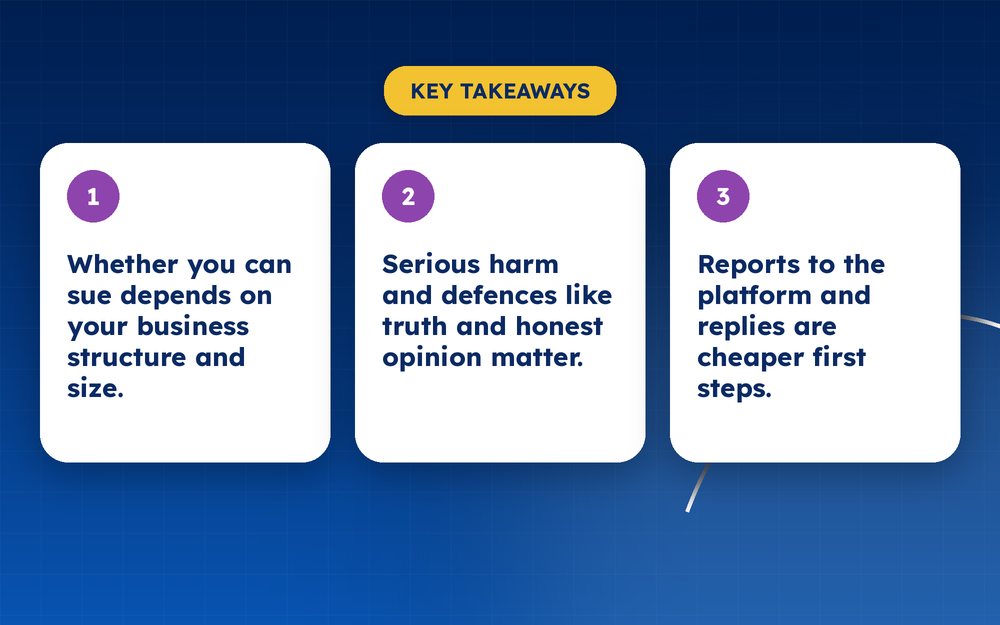
- Whether you can sue depends on your business structure and size.
- Serious harm and defences like truth and honest opinion matter.
- Reports to the platform and replies are cheaper first steps.
How to think about it, step by step
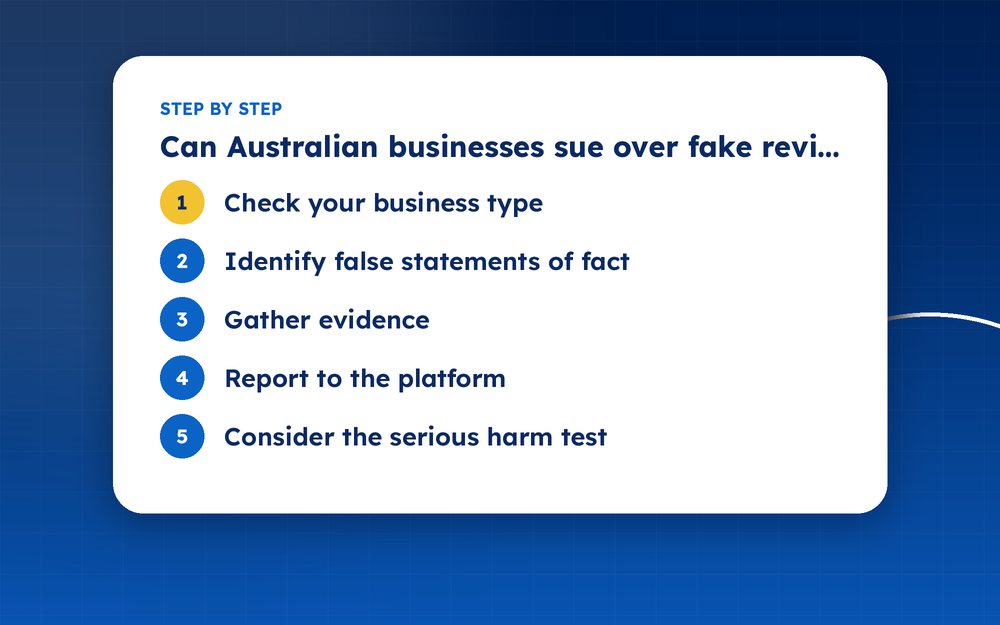
- Check your business typeNote your structure and number of employees, which affect who can sue. Whether a business can sue may depend on its size and structure. A lawyer can tell you whether yours is eligible.
- Identify false statements of factSeparate facts from opinions. Identify exactly which statements are claims of fact, and prove why they are false.
- Gather evidenceSave the review and records that show the facts. Save the review, dates, records and evidence of the effect on your business.
- Report to the platformFlag policy breaches for removal. Report the review to the platform. It is cheap and quick, and may solve the problem.
- Consider the serious harm testThink about how the review has harmed your business. Defamation law may require serious harm to reputation. A lawyer can explain how it is applied and what evidence helps.
- Speak to a lawyerAsk about your standing, costs and the chance of success. Ask a lawyer about concerns notices, costs, risks and alternatives before you act.
- Build genuine reviewsKeep your reputation strong with honest feedback. Keep building genuine reviews and replying calmly.
Why business size matters
The rules restrict many companies from suing for defamation to protect free speech. Small businesses can sue, but larger corporations usually cannot. If your business is a company, ask a lawyer whether you qualify.
Serious harm and concerns notices
Recent reforms added a serious harm threshold and a concerns notice process before suing. These steps are designed to encourage early resolution. A lawyer can explain how they work for reviews.
Anonymous reviewers
If the reviewer is anonymous, there may be court processes to get their details from the platform. These take time and money, and results are not guaranteed.
Other regulators
The Australian Competition and Consumer Commission and state regulators take an interest in fake reviews, which can be a consumer law issue. Reporting a fake review scheme may be an option.
What a typical case looks like
A small shop owner is accused in a review of selling fake goods. She checks supplier records, saves evidence and reports to the platform. When it is not removed, she asks a lawyer, who explains whether her business can sue and what harm she must show. She decides to send a short factual reply and keep collecting genuine reviews, while holding the option of further action.
Her evidence preserved her options without forcing a decision.
Common mistakes to avoid
Do not threaten to sue without advice. Do not miss time limits. Do not offer incentives to remove reviews. And do not post angry replies.
How a specialist can help
A specialist team can prepare policy-based reports and organise evidence. We are not a law firm and cannot give legal advice. Email us in confidence.
Frequently asked questions
Can an Australian business sue over a fake review?
Sometimes, depending on the business and the facts. A lawyer can advise.
What is the serious harm test?
A requirement in some defamation law that the statement has caused or is likely to cause serious harm.
Is reporting to the platform worthwhile?
Yes. It is quick and cheap.
What evidence helps?
The review, proof of falsity and records of lost business.
Is there a time limit?
Yes. Speak to a lawyer early.
Is this legal advice?
No. It is general information, and laws differ by place. For claims or court action, speak to a qualified lawyer.
Need help with this?
Every situation is different. Email us the details in confidence and we will reply with an honest assessment of what can be done.
Contact us by email Google review removalThis guide is general information, not legal advice. DMCA Reputation is not a law firm.
Related guides
How to Unmask an Anonymous Reviewer Legally
How to unmask an anonymous reviewer legally: what courts consider, John Doe and disclosure orders in general, costs, privacy balance and alternatives. Not legal advice.
Read the guide · 4 min
What to Do When One Person Posts Multiple Fake Reviews
What to do when one person posts multiple fake reviews: spot the pattern, gather evidence, report to the platform and handle harassment or extortion attempts.
Read the guide · 3 min
How to Remove a Google Review: A Complete Guide for Business Owners
How to remove a Google review: what Google will remove, how to report it, how to appeal and what to do if it stays. A guide for business owners.
Read the guide · 6 min